
Textbook Question
CONCEPT PREVIEW Match each equation in Column I with the appropriate right triangle in Column II. In each case, the goal is to find the value of x.
x = 5 tan 38°
 Verified step by step guidance
 6:22
6:22
 4:45
4:45 2:22
2:22CONCEPT PREVIEW Match each equation in Column I with the appropriate right triangle in Column II. In each case, the goal is to find the value of x.
x = 5 tan 38°
CONCEPT PREVIEW Match each trigonometric function in Column I with its value in Column II. Choices may be used once, more than once, or not at all.
tan 45°
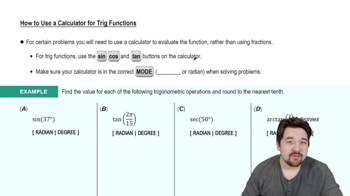
Use a calculator to approximate the value of each expression. Give answers to six decimal places. sec 222° 30'
CONCEPT PREVIEW Match each trigonometric function value or angle in Column I with its appropriate approximation in Column II.
Column I: 1.
tan 16°
Column II:
A. 88.09084757°
B. 63.25631605°
C. 1.909152433°
D. 17.45760312°
E. 0.2867453858
F. 1.962610506
G. 14.47751219°
H. 1.015426612
I. 1.051462224
J. 0.9925461516
Find a value of θ, in the interval [0°, 90°) that satisfies each statement. Give answers in decimal degrees to six decimal places. csc θ = 9.5670466
Use a calculator to approximate the value of each expression. Give answers to six decimal places. tan 11.7689°