Ch. 7 - Applications of Trigonometry and Vectors
Lial - Trigonometry 12th Edition
Lial12th EditionTrigonometryISBN: 9780136552161Not the one you use?Change textbook
Chapter 8, Problem 49

A plane has an airspeed of 520 mph. The pilot wishes to fly on a bearing of 310°. A wind of 37 mph is blowing from a bearing of 212°. In what direction should the pilot fly, and what will be her ground speed?

Verified step by step guidance
1
Identify the vectors involved: the plane's airspeed vector (magnitude 520 mph, direction to be found), the wind vector (magnitude 37 mph, coming from bearing 212°), and the resultant ground speed vector (desired bearing 310°).
Convert the wind's bearing to a direction the wind is blowing towards by adding 180° to the wind's bearing (since wind direction is given as where it comes from). Calculate the wind vector components using \( V_{wind_x} = 37 \times \cos\left(\frac{(212 + 180) \times \pi}{180}\right) \) and \( V_{wind_y} = 37 \times \sin\left(\frac{(212 + 180) \times \pi}{180}\right) \).
Express the desired ground speed vector components using the bearing 310°: \( V_{ground_x} = V_{ground} \times \cos\left(\frac{310 \times \pi}{180}\right) \) and \( V_{ground_y} = V_{ground} \times \sin\left(\frac{310 \times \pi}{180}\right) \), where \( V_{ground} \) is the unknown ground speed magnitude.
Set up the vector equation for the plane's airspeed vector \( \vec{V}_{plane} \) such that \( \vec{V}_{plane} + \vec{V}_{wind} = \vec{V}_{ground} \). Using components, this becomes two equations: \( V_{plane_x} + V_{wind_x} = V_{ground_x} \) and \( V_{plane_y} + V_{wind_y} = V_{ground_y} \).
Use the known magnitude of the plane's airspeed (520 mph) and the two component equations to solve for the plane's heading angle (direction to fly) and the ground speed magnitude \( V_{ground} \). This involves expressing \( V_{plane_x} = 520 \times \cos\theta \) and \( V_{plane_y} = 520 \times \sin\theta \), then solving the system for \( \theta \) and \( V_{ground} \).

Verified video answer for a similar problem:

This video solution was recommended by our tutors as helpful for the problem above.
Was this helpful?

Key Concepts

Here are the essential concepts you must grasp in order to answer the question correctly.

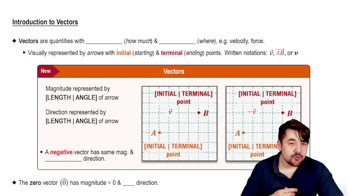
Vector Addition of Velocities

The plane's actual path over the ground is the vector sum of its airspeed and the wind velocity. To find the ground speed and direction, you add the velocity vector of the plane relative to the air to the wind's velocity vector, considering both magnitude and direction.
Recommended video:
03:48
Introduction to Vectors

Bearing and Angle Conversion

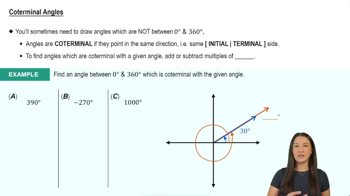
Bearings are measured clockwise from the north (0° to 360°). Converting bearings into standard angles for trigonometric calculations involves translating these compass directions into angles relative to the positive x-axis, often using sine and cosine functions to resolve vectors into components.
Recommended video:
04:46
Coterminal Angles

Trigonometric Resolution of Vectors

To analyze the problem, velocities are broken into horizontal (x) and vertical (y) components using sine and cosine of the given angles. This allows for precise calculation of resultant velocity magnitude and direction by recombining these components using the Pythagorean theorem and inverse trigonometric functions.
Recommended video:
03:48
Introduction to Vectors