In Exercises 49–59, find the exact value of each expression. Do not use a calculator. sin (22𝜋/3)
Verified step by step guidance
1
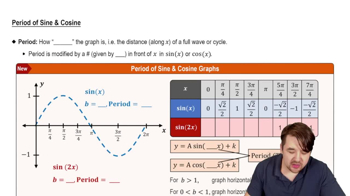
Recognize that the angle given is in radians: \(\frac{22\pi}{3}\). Since the sine function is periodic with period \(2\pi\), we can reduce the angle by subtracting multiples of \(2\pi\) to find a coterminal angle within the standard interval \([0, 2\pi)\).
Calculate how many full \(2\pi\) rotations fit into \(\frac{22\pi}{3}\). Since \(2\pi = \frac{6\pi}{3}\), divide \(\frac{22\pi}{3}\) by \(\frac{6\pi}{3}\) to find the quotient: \(\frac{22\pi/3}{6\pi/3} = \frac{22}{6} = 3 + \frac{4}{6} = 3 + \frac{2}{3}\).
Subtract \(3 \times 2\pi = 6\pi\) from \(\frac{22\pi}{3}\) to find the coterminal angle: \(\frac{22\pi}{3} - 6\pi = \frac{22\pi}{3} - \frac{18\pi}{3} = \frac{4\pi}{3}\).
Now, evaluate \(\sin \left( \frac{4\pi}{3} \right)\). Recall that \(\frac{4\pi}{3}\) is in the third quadrant where sine is negative, and it corresponds to an angle of \(\pi + \frac{\pi}{3}\).
Use the sine addition formula or reference the unit circle to express \(\sin \left( \frac{4\pi}{3} \right)\) as \(-\sin \left( \frac{\pi}{3} \right)\), and recall that \(\sin \left( \frac{\pi}{3} \right) = \frac{\sqrt{3}}{2}\).
Verified video answer for a similar problem:
This video solution was recommended by our tutors as helpful for the problem above
Video duration:
5m
Play a video:
0 Comments
Key Concepts
Here are the essential concepts you must grasp in order to answer the question correctly.
Radian Measure and Angle Conversion
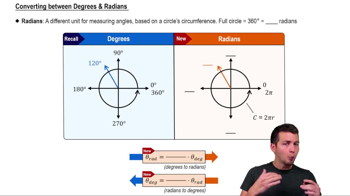
Radians are a way to measure angles based on the radius of a circle, where 2π radians equal 360 degrees. Understanding how to convert between radians and degrees or simplify radian measures is essential for evaluating trigonometric functions accurately.
The sine function is periodic with a period of 2π, meaning sin(θ) = sin(θ + 2πk) for any integer k. This property allows simplification of angles outside the standard interval [0, 2π) to equivalent angles within this range, facilitating exact value determination.
Certain angles, such as π/6, π/4, and π/3, have known exact sine values involving simple fractions and square roots. Decomposing or reducing complex angles into sums or differences of these special angles helps find exact sine values without a calculator.

 5:50 minutes
 Verified step by step guidance
 5:04
5:04