Ch. 2 - Acute Angles and Right Triangles
Lial - Trigonometry 12th Edition
Lial12th EditionTrigonometryISBN: 9780136552161Not the one you use?Change textbook
Chapter 3, Problem 2.3.38

Find a value of θ in the interval [0°, 90°) that satisfies each statement. Give answers in decimal degrees to six decimal places. See Example 2.
cos θ = 0.85536428

Verified step by step guidance
1
Identify the given equation: \(\cos \theta = 0.85536428\) and the interval for \(\theta\) is \([0^\circ, 90^\circ)\).
Recall that the cosine function is positive and decreasing in the first quadrant, so there will be one solution for \(\theta\) in the given interval.
Use the inverse cosine function to find \(\theta\): \(\theta = \cos^{-1}(0.85536428)\).
Calculate the value of \(\theta\) using a calculator set to degree mode to get the angle in degrees.
Round the result to six decimal places as required.

Verified video answer for a similar problem:

This video solution was recommended by our tutors as helpful for the problem above.
Video duration:
1m
Was this helpful?

Key Concepts

Here are the essential concepts you must grasp in order to answer the question correctly.

Cosine Function and Its Properties

The cosine function relates an angle in a right triangle to the ratio of the adjacent side over the hypotenuse. It is periodic and ranges between -1 and 1. Understanding its behavior on the interval [0°, 90°) is essential for finding the angle corresponding to a given cosine value.
Recommended video:
5:53
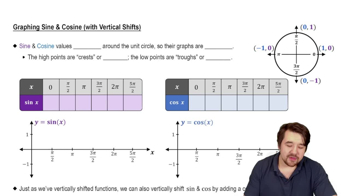
Graph of Sine and Cosine Function

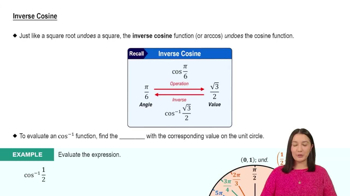
Inverse Cosine (Arccos) Function

The inverse cosine function, denoted arccos or cos⁻¹, returns the angle whose cosine is a given number. It is used to find the angle θ when cos θ is known, typically producing results in the range [0°, 180°]. For this problem, restricting the solution to [0°, 90°) is important.
Recommended video:
4:49
Inverse Cosine

Decimal Degree Precision

Decimal degree precision refers to expressing angles in degrees with decimal points, allowing for more exact measurements. Here, answers must be given to six decimal places, which requires careful calculation and rounding to ensure accuracy.
Recommended video:
5:04
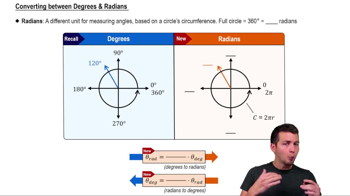
Converting between Degrees & Radians