
Textbook Question
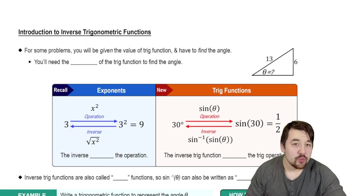
Find a value of θ in the interval [0°, 90°) that satisfies each statement. Give answers in decimal degrees to six decimal places. See Example 2.
cos θ = 0.85536428
1
views

 Verified step by step guidance
 6:22
6:22
 4:28
4:28 5:31
5:31Find a value of θ in the interval [0°, 90°) that satisfies each statement. Give answers in decimal degrees to six decimal places. See Example 2.
cos θ = 0.85536428
(Modeling) Grade Resistance Solve each problem. See Example 3. A car traveling on a -3° downhill grade has a grade resistance of -145 lb. Determine the weight of the car to the nearest hundred pounds.
CONCEPT PREVIEW Match the measure of bearing in Column I with the appropriate graph in Column II.
I. N 70° W
II. 1. A. B. C. 2. 3. 4. D. E. F. 5. N 70° W 6. 7. G. H. 8. 9. 10. I. J.
Concept Check The two methods of expressing bearing can be interpreted using a rectangular coordinate system. Suppose that an observer for a radar station is located at the origin of a coordinate system. Find the bearing of an airplane located at each point. Express the bearing using both methods. (-4, 0)
Use a calculator to determine whether each statement is true or false. A true statement may lead to results that differ in the last decimal place due to rounding error. ½ sin 40° = sin [½ (40°)]
Find two angles in the interval [0°, 360°) that satisfy each of the following. Round answers to the nearest degree. tan θ = 0.70020753