Ch. 9 - Inferences from Two Samples
Triola - Elementary Statistics 14th Edition
Triola14th EditionElementary StatisticsISBN: 9780137366446Not the one you use?Change textbook
Chapter 9, Problem 9.CR.3

In Exercises 1–10, based on the nature of the given data, do the following:


a. Pose a key question that is relevant to the given data.
b. Identify a procedure or tool from this chapter or the preceding chapters to address the key question from part (a).
c. Analyze the data and state a conclusion.


Video Games In a survey of subjects aged 18–29, subjects were asked if they play video games often or sometimes. Among 1017 males, 72% answered “yes.” Among 984 females, 49% answered “yes” (based on data from a Pew Research Center survey).

Verified step by step guidance
1
Step 1: Pose a key question relevant to the data. For example, 'Is there a significant difference in the proportion of males and females aged 18–29 who play video games often or sometimes?'
Step 2: Identify the appropriate statistical procedure to address the key question. In this case, a hypothesis test for the difference between two population proportions (e.g., a two-proportion z-test) is suitable.
Step 3: Define the null and alternative hypotheses. The null hypothesis (H₀) is that the proportions of males and females who play video games are equal (p₁ = p₂). The alternative hypothesis (H₁) is that the proportions are not equal (p₁ ≠ p₂).
Step 4: Calculate the test statistic using the formula for the z-test for two proportions: z=(p1-p2)(pc)(1-pc)(1n1+1n2), where p₁ and p₂ are the sample proportions, n₁ and n₂ are the sample sizes, and pₐ is the pooled proportion.
Step 5: Compare the calculated z-value to the critical z-value (or use the p-value approach) at the chosen significance level (e.g., α = 0.05). Based on this comparison, decide whether to reject or fail to reject the null hypothesis and state the conclusion in the context of the problem.

Verified video answer for a similar problem:

This video solution was recommended by our tutors as helpful for the problem above.
Video duration:
4m
Was this helpful?

Key Concepts

Here are the essential concepts you must grasp in order to answer the question correctly.

Descriptive Statistics

Descriptive statistics summarize and describe the main features of a dataset. This includes measures such as mean, median, mode, and percentages, which help in understanding the distribution and trends within the data. In the context of the survey, calculating the percentage of males and females who play video games provides a clear overview of gaming habits among different genders.
Recommended video:
Guided course
05:53
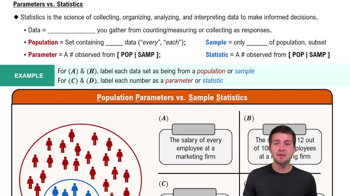
Parameters vs. Statistics

Hypothesis Testing

Hypothesis testing is a statistical method used to make inferences or draw conclusions about a population based on sample data. It involves formulating a null hypothesis and an alternative hypothesis, then using statistical tests to determine if there is enough evidence to reject the null hypothesis. In this case, one might test whether there is a significant difference in gaming frequency between males and females.
Recommended video:
Guided course
06:21
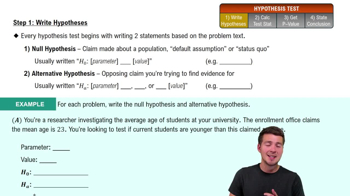
Step 1: Write Hypotheses

Data Analysis Techniques

Data analysis techniques encompass various methods used to inspect, clean, and model data to discover useful information. Techniques such as chi-square tests for categorical data or t-tests for comparing means can be applied to analyze the survey results. These methods help in drawing conclusions about the gaming habits of different demographics based on the collected data.
Recommended video:
Guided course
04:39
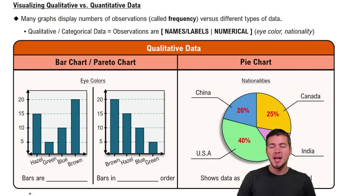
Visualizing Qualitative vs. Quantitative Data
Related Practice
Textbook Question

Bootstrapping and Randomization When resampling data from two independent samples, what is the fundamental difference between bootstrapping and randomization?
Textbook Question

In Exercises 5–8, use (a) randomization and (b) bootstrapping for the indicated exercise from Section 9-1. Compare the results to those obtained in the original exercise.


Exercise 7 in Section 9-1 “Buttered Toast Drop”

Textbook Question

Variation Find the value of the test statistic used for testing the claim that the two samples from Exercise 5 are from populations having the same variation.

Textbook Question

In Exercises 1–10, based on the nature of the given data, do the following:


a. Pose a key question that is relevant to the given data.

b. Identify a procedure or tool from this chapter or the preceding chapters to address the key question from part (a).

c. Analyze the data and state a conclusion.


Video Games In a survey of subjects aged 18–29, subjects were asked if they play video games often or sometimes. Among 984 females, 49% answered “yes” (based on data from a Pew Research Center survey).

Textbook Question

In Exercises 1–10, based on the nature of the given data, do the following:


a. Pose a key question that is relevant to the given data.

b. Identify a procedure or tool from this chapter or the preceding chapters to address the key question from part (a).

c. Analyze the data and state a conclusion.


IQ Scores of Twins Listed below are IQ scores of twins listed in Data Set 12 “IQ and Brain Size” in Appendix B. The data are pairs of IQ scores from ten different families.


Textbook Question

Sampling Methods A student obtains a sample of responses to the question “Do you plan to take or have you taken a statistics course?” A second student obtains a sample of responses to the same question. The first student surveys only males at the same college, and the second student surveys only females at the same college. What is wrong with the samples? Can randomization be used to overcome the flaws of those samples?