Ch. 9 - Inferences from Two Samples
Triola - Elementary Statistics 14th Edition
Triola14th EditionElementary StatisticsISBN: 9780137366446Not the one you use?Change textbook
Chapter 9, Problem 9.QQ.1

Identifying Hypotheses In a randomized clinical trial of adults with an acute sore throat, 288 were treated with the drug dexamethasone and 102 of them experienced complete resolution; 277 were treated with a placebo and 75 of them experienced complete resolution (based on data from “Effect of Oral Dexamethasone Without Immediate Antibiotics vs Placebo on Acute Sore Throat in Adults,” by Hayward et al., Journal of the American Medical Association). Identify the null and alternative hypotheses corresponding to the claim that patients treated with dexamethasone and patients given a placebo have the same rate of complete resolution.

Verified step by step guidance
1
Step 1: Understand the context of the problem. The claim is about comparing the rates of complete resolution between two groups: those treated with dexamethasone and those given a placebo. This is a hypothesis testing problem involving proportions.
Step 2: Define the null hypothesis (H₀). The null hypothesis represents the assumption that there is no difference in the rates of complete resolution between the two groups. Mathematically, this can be expressed as: pd=pp, where pd is the proportion of patients treated with dexamethasone who experienced complete resolution, and pp is the proportion of patients given a placebo who experienced complete resolution.
Step 3: Define the alternative hypothesis (H₁). The alternative hypothesis represents the claim that the rates of complete resolution are different between the two groups. Mathematically, this can be expressed as: pdpp.
Step 4: Note the type of test. Since the alternative hypothesis involves a 'not equal to' comparison (), this is a two-tailed test. The test will evaluate whether the proportions are significantly different in either direction.
Step 5: Prepare for hypothesis testing. To test these hypotheses, you would calculate the test statistic using the sample proportions and sample sizes provided. Then, compare the test statistic to the critical value or use the p-value approach to determine whether to reject the null hypothesis.

Verified video answer for a similar problem:

This video solution was recommended by our tutors as helpful for the problem above.
Video duration:
1m
Was this helpful?

Key Concepts

Here are the essential concepts you must grasp in order to answer the question correctly.

Null Hypothesis (H0)

The null hypothesis is a statement that there is no effect or no difference between groups in a study. In this context, it posits that the rate of complete resolution of sore throat is the same for patients treated with dexamethasone and those given a placebo. It serves as a baseline for statistical testing, allowing researchers to determine if observed differences are statistically significant.
Recommended video:
Guided course
06:21
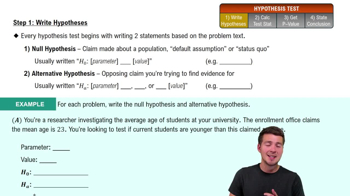
Step 1: Write Hypotheses

Alternative Hypothesis (H1)

The alternative hypothesis is a statement that indicates the presence of an effect or a difference between groups. In this scenario, it suggests that there is a difference in the rate of complete resolution between patients treated with dexamethasone and those receiving a placebo. This hypothesis is what researchers aim to support through their data analysis, often leading to further investigation if the null hypothesis is rejected.
Recommended video:
Guided course
06:21
Step 1: Write Hypotheses

Statistical Significance

Statistical significance refers to the likelihood that a relationship observed in data is not due to random chance. In hypothesis testing, researchers use p-values to determine if the results are statistically significant, typically using a threshold (e.g., p < 0.05). If the null hypothesis is rejected based on significant results, it suggests that the treatment (dexamethasone) may have a real effect on the resolution of sore throat compared to the placebo.
Recommended video:
Guided course
05:53
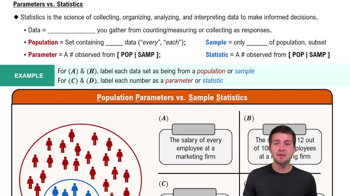
Parameters vs. Statistics
Related Practice
Textbook Question

Smoking Cessation Programs


a. Construct the confidence interval that could be used to test the claim in Exercise 5. What feature of the confidence interval leads to the same conclusion from Exercise 5?
Textbook Question

Test Values p_cap1, p_cap2. Find the values of and the pooled proportion p_bar obtained when testing the claim given in Exercise 1.

1
views
Textbook Question

Body Temperatures Listed below are body temperatures from six different subjects measured at two different times in a day (from Data Set 5 “Body Temperatures” in Appendix B).


b. Identify the null and alternative hypotheses for using the sample data to test the claim that the differences between 8 AM temperatures and 12 AM temperatures are from a population with a mean equal to 0°F

Textbook Question

Variation Find the value of the test statistic used for testing the claim that the two samples from Exercise 5 are from populations having the same variation.

Textbook Question

In Exercises 1–10, based on the nature of the given data, do the following:


a. Pose a key question that is relevant to the given data.

b. Identify a procedure or tool from this chapter or the preceding chapters to address the key question from part (a).

c. Analyze the data and state a conclusion.


Video Games In a survey of subjects aged 18–29, subjects were asked if they play video games often or sometimes. Among 984 females, 49% answered “yes” (based on data from a Pew Research Center survey).

Textbook Question

In Exercises 1–10, based on the nature of the given data, do the following:


a. Pose a key question that is relevant to the given data.

b. Identify a procedure or tool from this chapter or the preceding chapters to address the key question from part (a).

c. Analyze the data and state a conclusion.


IQ Scores of Twins Listed below are IQ scores of twins listed in Data Set 12 “IQ and Brain Size” in Appendix B. The data are pairs of IQ scores from ten different families.