
Ch. 8 - Hypothesis Testing
Triola - Elementary Statistics 14th Edition
Triola14th EditionElementary StatisticsISBN: 9780137366446Not the one you use?Change textbook
Chapter 8, Problem 8.1.9

Test Statistics
In Exercises 9–12, refer to the exercise identified and find the value of the test statistic. (Refer to Table 8-2 to select the correct expression for evaluating the test statistic.)


Exercise 5 “Landline Phones”

Verified step by step guidance
1
Identify the type of hypothesis test being conducted (e.g., z-test, t-test, chi-square test, etc.) based on the context of the problem and the data provided in Exercise 5 'Landline Phones'. Refer to Table 8-2 for guidance on the appropriate test statistic formula.
Determine the null hypothesis (H₀) and the alternative hypothesis (H₁) for the problem. Clearly state what is being tested (e.g., population mean, proportion, variance, etc.).
Collect the necessary data from the problem, such as the sample size (n), sample mean (x̄), population mean (μ), standard deviation (σ or s), or proportions (p̂ and p).
Substitute the collected values into the appropriate test statistic formula. For example, if it is a z-test for a population mean, use the formula: μσn. If it is a t-test, use the t-test formula instead.
Simplify the expression to calculate the test statistic value. Ensure all calculations are performed correctly, but do not compute the final numerical value here.

Verified video answer for a similar problem:

This video solution was recommended by our tutors as helpful for the problem above.
Video duration:
1m
Was this helpful?

Key Concepts

Here are the essential concepts you must grasp in order to answer the question correctly.

Test Statistic

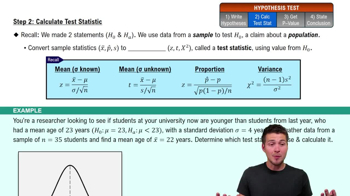
A test statistic is a standardized value that is calculated from sample data during a hypothesis test. It measures the degree to which the sample data deviates from the null hypothesis, allowing researchers to determine whether to reject or fail to reject the null hypothesis. Common test statistics include the t-statistic and z-statistic, which are used depending on the sample size and whether the population standard deviation is known.
Recommended video:
Guided course
06:34
Step 2: Calculate Test Statistic

Hypothesis Testing

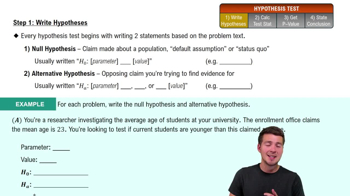
Hypothesis testing is a statistical method used to make decisions about a population based on sample data. It involves formulating a null hypothesis (H0) and an alternative hypothesis (H1), then using a test statistic to evaluate the evidence against the null hypothesis. The outcome determines whether there is sufficient evidence to support the alternative hypothesis, typically assessed using a significance level (alpha).
Recommended video:
Guided course
06:21
Step 1: Write Hypotheses

Critical Value

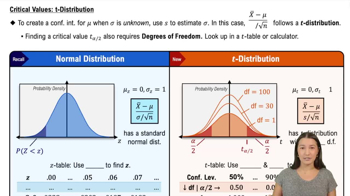
A critical value is a threshold that determines the boundary for rejecting the null hypothesis in hypothesis testing. It is derived from the chosen significance level and the distribution of the test statistic. If the calculated test statistic exceeds the critical value, the null hypothesis is rejected, indicating that the sample provides enough evidence to support the alternative hypothesis.
Recommended video:
05:50
Critical Values: t-Distribution
Related Practice
Textbook Question

Statistical Literacy and Critical Thinking

In Exercises 1–4, use the results from a Hankook Tire Gauge Index survey of a simple random sample of 1020 adults. Among the 1020 respondents, 86% rated themselves as above average drivers. We want to test the claim that more than 3/4 of adults rate themselves as above average drivers.


Requirements Are the requirements of the hypothesis test all satisfied? Explain.

Textbook Question

Testing Claims About Proportions

In Exercises 9–32, test the given claim. Identify the null hypothesis, alternative hypothesis, test statistic, P-value, or critical value(s), then state the conclusion about the null hypothesis, as well as the final conclusion that addresses the original claim. Use the P-value method unless your instructor specifies otherwise. Use the normal distribution as an approximation to the binomial distribution, as described in Part 1 of this section.


Online Friends A Pew Research Center poll of 1060 teens aged 13 to 17 showed that 57% of them have made new friends online. Use a 0.01 significance level to test the claim that half of all teens have made new friends online.

Textbook Question

Final Conclusions

In Exercises 21–24, use a significance level of α = 0.05 and use the given information for the following:


State a conclusion about the null hypothesis. (Reject H0 or fail to reject H0.)

Without using technical terms or symbols, state a final conclusion that addresses the original claim


Original claim: More than 35% of air travelers would choose another airline to have access to inflight Wi-Fi. The hypothesis test results in a P-value of 0.00001.

1
views
Textbook Question

Testing Claims About Variation

In Exercises 5–16, test the given claim. Identify the null hypothesis, alternative hypothesis, test statistic, P-value, or critical value(s), then state the conclusion about the null hypothesis, as well as the final conclusion that addresses the original claim. Assume that a simple random sample is selected from a normally distributed population.


Birth Weights A simple random sample of birth weights of 30 girls has a standard deviation of 829.5 g. Use a 0.01 significance level to test the claim that birth weights of girls have the same standard deviation as birth weights of boys, which is 660.2 g (based on Data Set 6 “Births” in Appendix B).

Textbook Question

Type I and Type II Errors

In Exercises 25–28, provide statements that identify the type I error and the type II error that correspond to the given claim. (Although conclusions are usually expressed in verbal form, the answers here can be expressed with statements that include symbolic expressions such as p = 0.1.)


The proportion of drivers who make angry gestures is greater than 0.25.

Textbook Question

Identifying H0 and H1

In Exercises 5–8, do the following:


a. Express the original claim in symbolic form.

b. Identify the null and alternative hypotheses.


Landline Phones Claim: Fewer than 10% of homes have only a landline telephone and no wireless phone. Sample data: A survey by the National Center for Health Statistics showed that among 16,113 homes, 5.8% had landline phones without wireless phones.