
Textbook Question
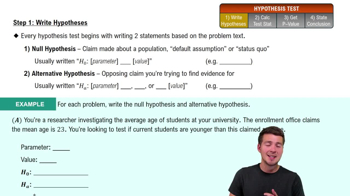
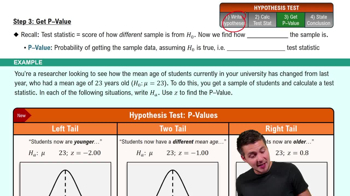
Test Statistics
In Exercises 9–12, refer to the exercise identified and find the value of the test statistic. (Refer to Table 8-2 to select the correct expression for evaluating the test statistic.)
Exercise 5 “Landline Phones”

 Verified step by step guidance
 06:21
06:21
 06:50
06:50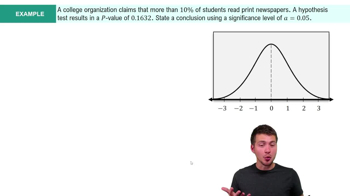 04:46
04:46Test Statistics
In Exercises 9–12, refer to the exercise identified and find the value of the test statistic. (Refer to Table 8-2 to select the correct expression for evaluating the test statistic.)
Exercise 5 “Landline Phones”
Interpreting P-value The Ericsson method is one of several methods claimed to increase the likelihood of a baby girl. In a clinical trial, results could be analyzed with a formal hypothesis test with the alternative hypothesis of p > 0.5 which corresponds to the claim that the method increases the likelihood of having a girl, so that the proportion of girls is greater than 0.5. If you have an interest in establishing the success of the method, which of the following P-values would you prefer as a result in your hypothesis test: 0.999, 0.5, 0.95, 0.05, 0.01, 0.001? Why?
Testing Claims About Proportions
In Exercises 9–32, test the given claim. Identify the null hypothesis, alternative hypothesis, test statistic, P-value, or critical value(s), then state the conclusion about the null hypothesis, as well as the final conclusion that addresses the original claim. Use the P-value method unless your instructor specifies otherwise. Use the normal distribution as an approximation to the binomial distribution, as described in Part 1 of this section.
Online Friends A Pew Research Center poll of 1060 teens aged 13 to 17 showed that 57% of them have made new friends online. Use a 0.01 significance level to test the claim that half of all teens have made new friends online.
Testing Claims About Variation
In Exercises 5–16, test the given claim. Identify the null hypothesis, alternative hypothesis, test statistic, P-value, or critical value(s), then state the conclusion about the null hypothesis, as well as the final conclusion that addresses the original claim. Assume that a simple random sample is selected from a normally distributed population.
Birth Weights A simple random sample of birth weights of 30 girls has a standard deviation of 829.5 g. Use a 0.01 significance level to test the claim that birth weights of girls have the same standard deviation as birth weights of boys, which is 660.2 g (based on Data Set 6 “Births” in Appendix B).
Exact Method For each of the three different methods of hypothesis testing (identified in the left column), enter the P-values corresponding to the given alternative hypothesis and sample data. Use a 0.05 significance level. Note that the entries in the last column correspond to the Chapter Problem. How do the results agree with the large sample size?
Type I and Type II Errors
In Exercises 25–28, provide statements that identify the type I error and the type II error that correspond to the given claim. (Although conclusions are usually expressed in verbal form, the answers here can be expressed with statements that include symbolic expressions such as p = 0.1.)
The proportion of drivers who make angry gestures is greater than 0.25.