

Ch. 6 - Normal Probability Distributions
Triola - Elementary Statistics 14th Edition
Triola14th EditionElementary StatisticsISBN: 9780137366446Not the one you use?Change textbook
Chapter 6, Problem 6.6.18a

Sleepwalking Assume that 29.2% of people have sleepwalked (based on “Prevalence and Comorbidity of Nocturnal Wandering in the U.S. Adult General Population, by Ohayon et al., Neurology, Vol. 78, No. 20). Assume that in a random sample of 1480 adults, 455 have sleepwalked.


a. Assuming that the rate of 29.2% is correct, find the probability that 455 or more of the 1480 adults have sleepwalked.

Verified step by step guidance
1
Step 1: Identify the type of probability distribution to use. Since we are dealing with a proportion (29.2%) and a large sample size (1480 adults), we can approximate the binomial distribution using the normal distribution. This is valid under the conditions that both np and n(1-p) are greater than 5, where n is the sample size and p is the probability of success.
Step 2: Calculate the mean (μ) and standard deviation (σ) of the binomial distribution. The mean is given by μ = np, and the standard deviation is given by σ = √(np(1-p)). Substitute n = 1480 and p = 0.292 into these formulas.
Step 3: Convert the problem into a z-score calculation. To find the probability of 455 or more adults sleepwalking, we first calculate the z-score using the formula z = (X - μ) / σ, where X is the observed number of successes (455), μ is the mean, and σ is the standard deviation.
Step 4: Use the z-score to find the corresponding probability. Look up the z-score in a standard normal distribution table or use statistical software to find the cumulative probability up to the z-score. Since we are interested in 455 or more, subtract this cumulative probability from 1.
Step 5: Interpret the result. The final probability represents the likelihood of observing 455 or more adults sleepwalking in a random sample of 1480, assuming the true proportion of sleepwalkers is 29.2%.

Verified video answer for a similar problem:

This video solution was recommended by our tutors as helpful for the problem above.
Video duration:
4m
Was this helpful?

Key Concepts

Here are the essential concepts you must grasp in order to answer the question correctly.

Binomial Distribution

The binomial distribution models the number of successes in a fixed number of independent Bernoulli trials, each with the same probability of success. In this context, sleepwalking can be considered a 'success,' and the distribution helps calculate the probability of observing a certain number of successes (455) in a sample of 1480 adults, given the known probability of sleepwalking (29.2%).
Recommended video:
Guided course
03:28
Mean & Standard Deviation of Binomial Distribution

Normal Approximation to the Binomial

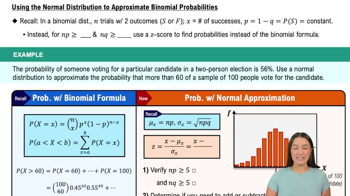
For large sample sizes, the binomial distribution can be approximated by a normal distribution, which simplifies calculations. This approximation is valid when both np and n(1-p) are greater than 5. In this case, it allows us to use the normal distribution to find the probability of observing 455 or more sleepwalkers in the sample of 1480 adults.
Recommended video:
06:23
Using the Normal Distribution to Approximate Binomial Probabilities

Hypothesis Testing

Hypothesis testing is a statistical method used to make inferences about population parameters based on sample data. In this scenario, we can set up a null hypothesis that the true proportion of sleepwalkers is 29.2% and use the sample data to determine if the observed number of sleepwalkers (455) significantly deviates from what we would expect under this hypothesis, thus assessing the validity of the assumption.
Recommended video:
Guided course
06:21
Step 1: Write Hypotheses
Related Practice
Textbook Question

Ergonomics. Exercises 9–16 involve applications to ergonomics, as described in the Chapter Problem.


Doorway Height The Boeing 757-200 ER airliner carries 200 passengers and has doors with a height of 72 in. Heights of men are normally distributed with a mean of 68.6 in. and a standard deviation of 2.8 in. (based on Data Set 1 “Body Data” in Appendix B).


a. If a male passenger is randomly selected, find the probability that he can fit through the doorway without bending.

Textbook Question

College Presidents There are about 4200 college presidents in the United States, and they have annual incomes with a distribution that is skewed instead of being normal. Many different samples of 40 college presidents are randomly selected, and the mean annual income is computed for each sample.

a. What is the approximate shape of the distribution of the sample means (uniform, normal, skewed, other)?

Textbook Question

Ergonomics. Exercises 9–16 involve applications to ergonomics, as described in the Chapter Problem.


Designing Manholes According to the website www.torchmate.com, “manhole covers must be a minimum of 22 in. in diameter, but can be as much as 60 in. in diameter.” Assume that a manhole is constructed to have a circular opening with a diameter of 22 in. Men have shoulder widths that are normally distributed with a mean of 18.2 in. and a standard deviation of 1.0 in. (based on data from the National Health and Nutrition Examination Survey).


a. What percentage of men will fit into the manhole?

Textbook Question

Curving Test Scores A professor gives a test and the scores are normally distributed with a mean of 60 and a standard deviation of 12. She plans to curve the scores.


a. If she curves by adding 15 to each grade, what is the new mean and standard deviation?

Textbook Question

In Exercises 7–10, use the same population of {4, 5, 9} that was used in Examples 2 and 5. As in Examples 2 and 5, assume that samples of size n = 2 are randomly selected with replacement.


Sampling Distribution of the Sample Variance


a. Find the value of the population variance σ2.

Textbook Question

Hershey Kisses Based on Data Set 38 “Candies” in Appendix B, weights of the chocolate in Hershey Kisses are normally distributed with a mean of 4.5338 g and a standard deviation of 0.1039 g.


a. What are the values of the mean and standard deviation after converting all weights of Hershey Kisses to z scores using z = (x - μ)/σ ?


b. The original weights are in grams. What are the units of the corresponding z scores?