Ch. 6 - Normal Probability Distributions
Triola - Elementary Statistics 14th Edition
Triola14th EditionElementary StatisticsISBN: 9780137366446Not the one you use?Change textbook
Chapter 6, Problem 6.2.1a

Hershey Kisses Based on Data Set 38 “Candies” in Appendix B, weights of the chocolate in Hershey Kisses are normally distributed with a mean of 4.5338 g and a standard deviation of 0.1039 g.


a. What are the values of the mean and standard deviation after converting all weights of Hershey Kisses to z scores using z = (x - μ)/σ ?


b. The original weights are in grams. What are the units of the corresponding z scores?

Verified step by step guidance
1
Step 1: Understand the z-score formula. The z-score is calculated using the formula: z=x-μσ, where x is the individual data point, μ is the mean, and σ is the standard deviation.
Step 2: Analyze part (a). When converting all weights to z-scores, the mean of the z-scores will always be 0, and the standard deviation of the z-scores will always be 1. This is because the z-score transformation standardizes the data by centering it around 0 and scaling it by the standard deviation.
Step 3: Address part (b). The original weights are measured in grams. However, z-scores are unitless because they represent the number of standard deviations a data point is from the mean. Units are removed during the z-score calculation.
Step 4: Summarize the results. For part (a), the mean of the z-scores is 0, and the standard deviation is 1. For part (b), the z-scores have no units—they are dimensionless.
Step 5: Reflect on the importance of z-scores. Z-scores are useful for comparing data points from different distributions or for identifying how extreme a data point is relative to its distribution.

Verified video answer for a similar problem:

This video solution was recommended by our tutors as helpful for the problem above.
Video duration:
4m
Was this helpful?

Key Concepts

Here are the essential concepts you must grasp in order to answer the question correctly.

Normal Distribution

Normal distribution is a probability distribution that is symmetric about the mean, showing that data near the mean are more frequent in occurrence than data far from the mean. It is characterized by its bell-shaped curve, defined by its mean (μ) and standard deviation (σ). In this context, the weights of Hershey Kisses follow a normal distribution, which allows for the application of z-scores to standardize the data.
Recommended video:
Guided course
09:47
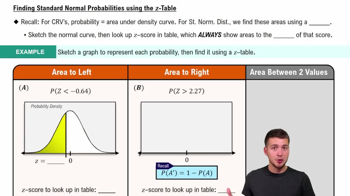
Finding Standard Normal Probabilities using z-Table

Z-Score

A z-score is a statistical measurement that describes a value's relationship to the mean of a group of values. It is calculated using the formula z = (x - μ) / σ, where x is the value, μ is the mean, and σ is the standard deviation. The z-score indicates how many standard deviations an element is from the mean, allowing for comparison across different datasets.
Recommended video:
Guided course
06:31
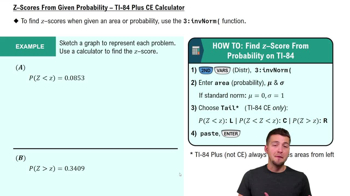
Z-Scores From Given Probability - TI-84 (CE) Calculator

Units of Measurement

Units of measurement provide a standard for quantifying physical quantities. In the case of z-scores, they are dimensionless because they represent a standardized value derived from the original data. While the original weights of Hershey Kisses are measured in grams, the z-scores do not have units, as they express relative position rather than absolute measurement.
Recommended video:
Guided course
05:53
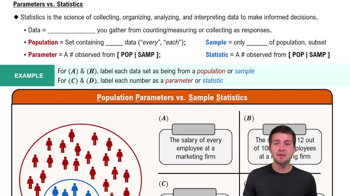
Parameters vs. Statistics
Related Practice
Textbook Question

Fatal Car Crashes There are about 15,000 car crashes each day in the United States, and the proportion of car crashes that are fatal is 0.00559 (based on data from the National Highway Traffic Safety Administration). Assume that each day, 1000 car crashes are randomly selected and the proportion of fatal car crashes is recorded.

a. What do you know about the mean of the sample proportions?

Textbook Question

Ergonomics. Exercises 9–16 involve applications to ergonomics, as described in the Chapter Problem.


Water Taxi Safety Passengers died when a water taxi sank in Baltimore’s Inner Harbor. Men are typically heavier than women and children, so when loading a water taxi, assume a worst-case scenario in which all passengers are men. Assume that weights of men are normally distributed with a mean of 189 lb and a standard deviation of 39 lb (based on Data Set 1 “Body Data” in Appendix B). The water taxi that sank had a stated capacity of 25 passengers, and the boat was rated for a load limit of 3500 lb.


a. Given that the water taxi that sank was rated for a load limit of 3500 lb, what is the maximum mean weight of the passengers if the boat is filled to the stated capacity of 25 passengers?

Textbook Question

Body Temperatures Listed below are body temperatures (°F) of adult males (based on Data Set 5 “Body Temperatures” in Appendix B).


97.6 98.2 99.6 98.7 99.4 98.2 98.0 98.6 98.6


a. Find the mean. Does the result seem reasonable?

1
views
Textbook Question

Ergonomics. Exercises 9–16 involve applications to ergonomics, as described in the Chapter Problem.


Designing Manholes According to the website www.torchmate.com, “manhole covers must be a minimum of 22 in. in diameter, but can be as much as 60 in. in diameter.” Assume that a manhole is constructed to have a circular opening with a diameter of 22 in. Men have shoulder widths that are normally distributed with a mean of 18.2 in. and a standard deviation of 1.0 in. (based on data from the National Health and Nutrition Examination Survey).


a. What percentage of men will fit into the manhole?

Textbook Question

Sleepwalking Assume that 29.2% of people have sleepwalked (based on “Prevalence and Comorbidity of Nocturnal Wandering in the U.S. Adult General Population, by Ohayon et al., Neurology, Vol. 78, No. 20). Assume that in a random sample of 1480 adults, 455 have sleepwalked.


a. Assuming that the rate of 29.2% is correct, find the probability that 455 or more of the 1480 adults have sleepwalked.

Textbook Question

Curving Test Scores A professor gives a test and the scores are normally distributed with a mean of 60 and a standard deviation of 12. She plans to curve the scores.


a. If she curves by adding 15 to each grade, what is the new mean and standard deviation?