Ch. 6 - Normal Probability Distributions
Triola - Elementary Statistics 14th Edition
Triola14th EditionElementary StatisticsISBN: 9780137366446Not the one you use?Change textbook
Chapter 6, Problem 6.CRE.1b

In Exercises 1 and 2, use the following wait times (minutes) at 10:00 AM for the Tower of Terror ride at Disney World (from Data Set 33 “Disney World Wait Times” in Appendix B).


35 35 20 50 95 75 45 50 30 35 30 30 


b. Find the median.

Verified step by step guidance
1
Step 1: Organize the data in ascending order. The given wait times are: 35, 35, 20, 50, 95, 75, 45, 50, 30, 35, 30, 30. Arrange these values in increasing order: 20, 30, 30, 30, 35, 35, 35, 45, 50, 50, 75, 95.
Step 2: Determine the total number of data points. Count the number of values in the dataset. In this case, there are 12 data points.
Step 3: Identify whether the number of data points is odd or even. Since there are 12 data points (an even number), the median will be the average of the two middle values.
Step 4: Locate the two middle values. For an even dataset, the two middle values are at positions n/2 and (n/2) + 1, where n is the total number of data points. Here, n = 12, so the middle values are at positions 12/2 = 6 and (12/2) + 1 = 7. The 6th and 7th values in the ordered dataset are 35 and 35.
Step 5: Calculate the median. The median is the average of the two middle values. Use the formula: Median = (Value at position 6 + Value at position 7) / 2. Substitute the values from Step 4 to find the median.

Verified video answer for a similar problem:

This video solution was recommended by our tutors as helpful for the problem above.
Video duration:
2m
Was this helpful?

Key Concepts

Here are the essential concepts you must grasp in order to answer the question correctly.

Median

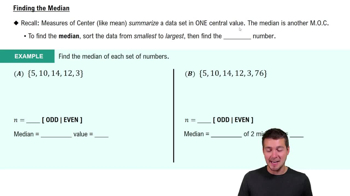
The median is a measure of central tendency that represents the middle value in a data set when the numbers are arranged in ascending order. If there is an odd number of observations, the median is the middle number; if even, it is the average of the two middle numbers. It is particularly useful for understanding the distribution of data, especially when there are outliers that could skew the mean.
Recommended video:
Guided course
03:26
Calculating the Median

Data Set Organization

Organizing a data set involves sorting the values in either ascending or descending order, which is essential for accurately calculating statistical measures like the median. This process helps to visualize the data and identify patterns or trends, making it easier to analyze the information effectively.
Recommended video:
Guided course
04:39
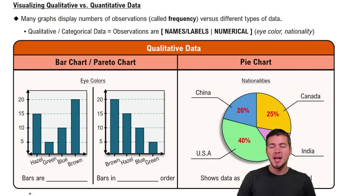
Visualizing Qualitative vs. Quantitative Data

Descriptive Statistics

Descriptive statistics summarize and describe the main features of a data set, providing simple summaries about the sample and the measures. This includes measures of central tendency (like mean, median, and mode) and measures of variability (like range and standard deviation). Understanding these statistics is crucial for interpreting data and making informed decisions based on the analysis.
Recommended video:
Guided course
05:53
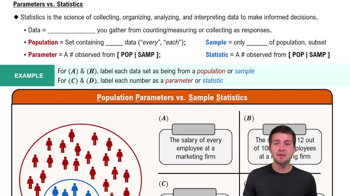
Parameters vs. Statistics
Related Practice
Textbook Question

In Exercises 1 and 2, use the following wait times (minutes) at 10:00 AM for the Tower of Terror ride at Disney World (from Data Set 33 “Disney World Wait Times” in Appendix B).


35 35 20 50 95 75 45 50 30 35 30 30


b. Construct a boxplot.

Textbook Question

Foot Lengths of Women Assume that foot lengths of adult females are normally distributed with a mean of 246.3 mm and a standard deviation of 12.4 mm (based on Data Set 3 “ANSUR II 2012” in Appendix B).


a. Find the probability that a randomly selected adult female has a foot length less than 221.5 mm.

Textbook Question

Normal Distribution Using a larger data set than the one given for the preceding exercises, assume that cell phone radiation amounts are normally distributed with a mean of 1.17 W/kg and a standard deviation of 0.29 W/kg.

a. Find the probability that a randomly selected cell phone has a radiation amount that exceeds the U.S. standard of 1.6 W/kg or less.

Textbook Question

Foot Lengths of Women Assume that foot lengths of adult females are normally distributed with a mean of 246.3 mm and a standard deviation of 12.4 mm (based on Data Set 3 “ANSUR II 2012” in Appendix B).


c. Find P95.

Textbook Question

In Exercises 1 and 2, use the following wait times (minutes) at 10:00 AM for the Tower of Terror ride at Disney World (from Data Set 33 “Disney World Wait Times” in Appendix B).


35 35 20 50 95 75 45 50 30 35 30 30


a. Find the mean xbar.

Textbook Question

Foot Lengths of Women Assume that foot lengths of adult females are normally distributed with a mean of 246.3 mm and a standard deviation of 12.4 mm (based on Data Set 3 “ANSUR II 2012” in Appendix B).


d. Find the probability that 16 adult females have foot lengths with a mean greater than 250 mm.