
Ch. 6 - Normal Probability Distributions
Triola - Elementary Statistics 14th Edition
Triola14th EditionElementary StatisticsISBN: 9780137366446Not the one you use?Change textbook
Chapter 6, Problem 6.CRE.1

In Exercises 1 and 2, use the following wait times (minutes) at 10:00 AM for the Tower of Terror ride at Disney World (from Data Set 33 “Disney World Wait Times” in Appendix B).


35 35 20 50 95 75 45 50 30 35 30 30


a. Find the mean xbar.

Verified step by step guidance
1
Step 1: Understand the concept of the mean (x̄). The mean is the average of a set of numbers, calculated by summing all the values and dividing by the total number of values.
Step 2: Write down the formula for the mean: =xn, where x represents the sum of all data points and n is the number of data points.
Step 3: Add up all the wait times provided in the data set: 35 + 35 + 20 + 50 + 95 + 75 + 45 + 50 + 30 + 35 + 30 + 30.
Step 4: Count the total number of data points in the set. In this case, there are 12 wait times.
Step 5: Divide the sum of the wait times by the total number of data points to calculate the mean: =xn.

Verified video answer for a similar problem:

This video solution was recommended by our tutors as helpful for the problem above.
Video duration:
1m
Was this helpful?

Key Concepts

Here are the essential concepts you must grasp in order to answer the question correctly.

Mean

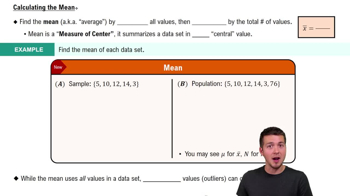
The mean, often referred to as the average, is a measure of central tendency that is calculated by summing all the values in a data set and then dividing by the number of values. It provides a single value that represents the center of the data distribution, making it useful for understanding the overall trend. In the context of wait times, the mean gives an indication of the typical wait time experienced by visitors.
Recommended video:
Guided course
04:52
Calculating the Mean

Data Set

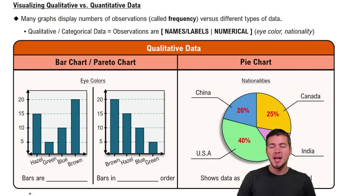
A data set is a collection of related values or observations that can be analyzed to extract meaningful information. In this case, the wait times for the Tower of Terror ride represent a specific data set. Understanding the structure and context of the data set is crucial for performing statistical calculations, such as finding the mean.
Recommended video:
Guided course
04:39
Visualizing Qualitative vs. Quantitative Data

Central Tendency

Central tendency refers to statistical measures that describe the center or typical value of a data set. The mean, median, and mode are all measures of central tendency, each providing different insights into the data. Recognizing these measures helps in interpreting data effectively, especially when comparing different sets of wait times or understanding variability.
Recommended video:
Guided course
04:52
Calculating the Mean
Related Practice
Textbook Question

In Exercises 1 and 2, use the following wait times (minutes) at 10:00 AM for the Tower of Terror ride at Disney World (from Data Set 33 “Disney World Wait Times” in Appendix B).


35 35 20 50 95 75 45 50 30 35 30 30


b. Construct a boxplot.

Textbook Question

In Exercises 1 and 2, use the following wait times (minutes) at 10:00 AM for the Tower of Terror ride at Disney World (from Data Set 33 “Disney World Wait Times” in Appendix B).


35 35 20 50 95 75 45 50 30 35 30 30


d. The accompanying normal quantile plot is obtained by using all 50 wait times at 10:00 AM for the Tower of Terror ride at Disney World. Based on this normal quantile plot, do the sample data appear to be from a normally distributed population?

2
views
Textbook Question

In Exercises 1 and 2, use the following wait times (minutes) at 10:00 AM for the Tower of Terror ride at Disney World (from Data Set 33 “Disney World Wait Times” in Appendix B).


35 35 20 50 95 75 45 50 30 35 30 30


e. Convert the longest wait time to a z score.

f. Based on the result from part (e), is the longest wait time significantly high?

Textbook Question

Blue Eyes Assume that 35% of us have blue eyes (based on a study by Dr. P. Soria at Indiana University).


b. Find the value of P(B_bar).

Textbook Question

Foot Lengths of Women Assume that foot lengths of adult females are normally distributed with a mean of 246.3 mm and a standard deviation of 12.4 mm (based on Data Set 3 “ANSUR II 2012” in Appendix B).


d. Find the probability that 16 adult females have foot lengths with a mean greater than 250 mm.

Textbook Question

In Exercises 1 and 2, use the following wait times (minutes) at 10:00 AM for the Tower of Terror ride at Disney World (from Data Set 33 “Disney World Wait Times” in Appendix B).


35 35 20 50 95 75 45 50 30 35 30 30 


b. Find the median.

1
views