Ch. 5 - Discrete Probability Distributions
Triola - Elementary Statistics 14th Edition
Triola14th EditionElementary StatisticsISBN: 9780137366446Not the one you use?Change textbook
Chapter 5, Problem 24b

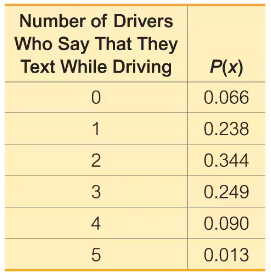
Texting and Driving. In Exercises 21–26, refer to the accompanying table, which describes probabilities for groups of five drivers. The random variable x is the number of drivers in a group who say that they text while driving (based on data from an Arity survey of drivers).
tab1
Using Probabilities for Significant Events


b. Find the probability of getting 3 or more drivers who say that they text while driving.

Verified step by step guidance
1
Step 1: Understand the problem. We are tasked with finding the probability of getting 3 or more drivers who say they text while driving. This means we need to calculate P(x ≥ 3), where x is the number of drivers in a group who text while driving.
Step 2: Use the complement rule to simplify the calculation. The complement of P(x ≥ 3) is P(x < 3). Therefore, P(x ≥ 3) = 1 - P(x < 3).
Step 3: Calculate P(x < 3) by summing the probabilities for x = 0, x = 1, and x = 2. From the table, these probabilities are P(0) = 0.066, P(1) = 0.238, and P(2) = 0.344.
Step 4: Add the probabilities for x = 0, x = 1, and x = 2 to find P(x < 3). This will give the total probability of having fewer than 3 drivers who text while driving.
Step 5: Subtract P(x < 3) from 1 to find P(x ≥ 3). This will give the probability of having 3 or more drivers who text while driving.

Verified video answer for a similar problem:

This video solution was recommended by our tutors as helpful for the problem above.
Video duration:
2m
Was this helpful?

Key Concepts

Here are the essential concepts you must grasp in order to answer the question correctly.

Random Variable

A random variable is a numerical outcome of a random phenomenon. In this context, the random variable x represents the number of drivers in a group of five who report texting while driving. Understanding random variables is crucial for analyzing probabilities and making inferences about populations based on sample data.
Recommended video:
Guided course
07:09
Intro to Random Variables & Probability Distributions

Probability Distribution

A probability distribution describes how probabilities are assigned to each possible value of a random variable. The table provided shows the probability distribution for the random variable x, indicating the likelihood of 0 to 5 drivers texting while driving. This distribution is essential for calculating probabilities of specific outcomes, such as finding the probability of 3 or more drivers texting.
Recommended video:
Guided course
06:39
Calculating Probabilities in a Binomial Distribution

Cumulative Probability

Cumulative probability refers to the probability that a random variable takes on a value less than or equal to a certain number. To find the probability of getting 3 or more drivers who text while driving, one must calculate the cumulative probabilities for 0, 1, and 2 drivers and subtract this sum from 1. This concept is vital for understanding how to aggregate probabilities for ranges of outcomes.
Recommended video:
5:37
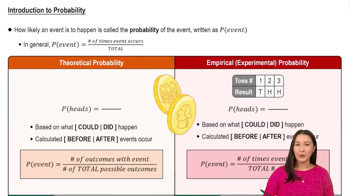
Introduction to Probability
Related Practice
Textbook Question

 In Exercises 5–8, assume that the Poisson distribution applies; assume that the mean number of Atlantic hurricanes in the United States is 5.5 per year, as in Example 1; and proceed to find the indicated probability.


Hurricanes


b. In a 118-year period, how many years are expected to have no hurricanes?

1
views
Textbook Question

Texting and Driving. In Exercises 21–26, refer to the accompanying table, which describes probabilities for groups of five drivers. The random variable x is the number of drivers in a group who say that they text while driving (based on data from an Arity survey of drivers).

For groups of five drivers, find the mean and standard deviation for the numbers of drivers who say that they text while driving.

2
views
Textbook Question

Texting and Driving. In Exercises 21–26, refer to the accompanying table, which describes probabilities for groups of five drivers. The random variable x is the number of drivers in a group who say that they text while driving (based on data from an Arity survey of drivers).

Using Probabilities for Significant Events

d. Is 3 a significantly high number of drivers who say that they text while driving? Why or why not?

1
views
Textbook Question

Texting and Driving. In Exercises 21–26, refer to the accompanying table, which describes probabilities for groups of five drivers. The random variable x is the number of drivers in a group who say that they text while driving (based on data from an Arity survey of drivers).

Range Rule of Thumb for Significant Events

Use the range rule of thumb to determine whether 1 is a significantly low number of drivers who say that they text while driving.

1
views