Ch. 4 - Probability
Triola - Elementary Statistics 14th Edition
Triola14th EditionElementary StatisticsISBN: 9780137366446Not the one you use?Change textbook
Chapter 4, Problem 4.4.29a

Mega Millions As of this writing, the Mega Millions lottery is run in 44 states. Winning the jackpot requires that you select the correct five different numbers from 1 to 70 and, in a separate drawing, you must also select the correct single number from 1 to 25.


a. Find the probability of winning the jackpot.

Verified step by step guidance
1
Step 1: Understand the problem. To win the Mega Millions jackpot, you must correctly select 5 different numbers from a pool of 70 numbers and 1 additional number (called the Mega Ball) from a separate pool of 25 numbers. The probability of winning is the reciprocal of the total number of possible combinations.
Step 2: Calculate the number of ways to choose 5 numbers from 70. Use the combination formula: C(n, k) = n! / [k!(n-k)!], where n is the total number of items, k is the number of items to choose, and '!' denotes factorial. Here, n = 70 and k = 5. Substitute these values into the formula: C(70, 5) = 70! / [5!(70-5)!].
Step 3: Calculate the number of ways to choose 1 number from 25. Since this is a single choice, the number of ways is simply 25.
Step 4: Multiply the results from Step 2 and Step 3 to find the total number of possible outcomes. The total number of outcomes is given by: Total Outcomes = C(70, 5) × 25.
Step 5: Find the probability of winning the jackpot. The probability is the reciprocal of the total number of outcomes calculated in Step 4. Probability = 1 / (C(70, 5) × 25).

Verified video answer for a similar problem:

This video solution was recommended by our tutors as helpful for the problem above.
Video duration:
3m
Was this helpful?

Key Concepts

Here are the essential concepts you must grasp in order to answer the question correctly.

Probability

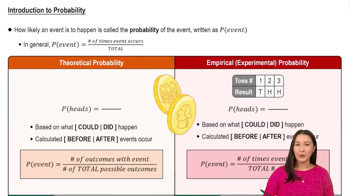
Probability is a measure of the likelihood that a particular event will occur, expressed as a number between 0 and 1. In the context of lotteries, it quantifies the chance of winning based on the total number of possible outcomes. For example, if there are 70 numbers to choose from and you need to select 5, the probability of selecting the correct combination is calculated using combinatorial methods.
Recommended video:
5:37
Introduction to Probability

Combinations

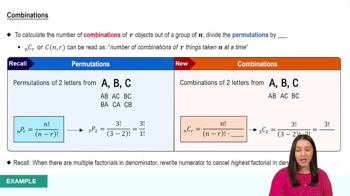
Combinations refer to the selection of items from a larger set where the order does not matter. In the Mega Millions lottery, you need to choose 5 different numbers from a pool of 70. The number of ways to choose these numbers is calculated using the combination formula, which is crucial for determining the total number of possible winning combinations.
Recommended video:
05:22
Combinations

Independent Events

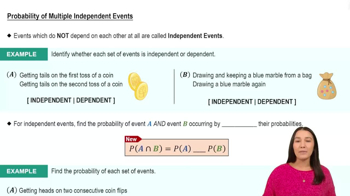
Independent events are those whose outcomes do not affect each other. In the Mega Millions lottery, the selection of the five numbers and the selection of the single number are independent events. This means that the probability of winning the jackpot is the product of the probabilities of each event occurring, which is essential for calculating the overall probability of winning.
Recommended video:
05:54
Probability of Multiple Independent Events
Related Practice
Textbook Question

High Fives


b. If n mathletes shake hands with each other exactly once, what is the total number of handshakes?

Textbook Question

Surge Protectors Refer to the accompanying figure showing surge protectors p and q used to protect an expensive television. If there is a surge in the voltage, the surge protector reduces it to a safe level. Assume that each surge protector has a 0.985 probability of working correctly when a voltage surge occurs.


a. If the two surge protectors are arranged in series, what is the probability that a voltage surge will not damage the television? (Do not round the answer.)

Textbook Question

Denomination Effect

In Exercises 13–16, use the data in the following table. In an experiment to study the effects of using four quarters versus a \$1 bill, some college students were given four quarters and others were given a \(1 bill, and they could either keep the money or spend it on gum. The results are summarized in the table (based on data from “The Denomination Effect,” by Priya Raghubir and Joydeep Srivastava, Journal of Consumer Research, Vol. 36).


Denomination Effect


a. Find the probability of randomly selecting a student who spent the money, given that the student was given a \)1 bill.


1
views
Textbook Question

In Exercises 9–20, use the data in the following table, which lists survey results from high school drivers at least 16 years of age (based on data from “Texting While Driving and Other Risky Motor Vehicle Behaviors Among U.S. High School Students,” by O’Malley, Shults, and Eaton, Pediatrics, Vol. 131, No. 6). Assume that subjects are randomly selected from those included in the table. Hint: Be very careful to read the question correctly.

Texting While Driving If two of the high school drivers are randomly selected, find the probability that they both texted while driving.

a. Assume that the selections are made with replacement. Are the events independent?

Textbook Question

Design Your Own Lottery You have been given the task of creating a new lottery. For each \$1 ticket, the player will select 6 different numbers from 1 to 25 (without replacement), and the only prize will be the jackpot won by players who select the six numbers (in any order) that are later drawn.


a. What is the probability of winning with one ticket?

Textbook Question

In Exercises 21-28, find the probability and answer the questions.


X-Linked Genetic Disease Men have XY (or YX) chromosomes and women have XX chromosomes. X-linked recessive genetic diseases (such as juvenile retinoschisis) occur when there is a defective X chromosome that occurs without a paired X chromosome that is not defective. In the following, represent a defective X chromosome with lowercase x, so a child with the xY or Yx pair of chromosomes will have the disease and a child with XX or XY or YX or xX or Xx will not have the disease. Each parent contributes one of the chromosomes to the child.


a. If a father has the defective x chromosome and the mother has good XX chromosomes, what is the probability that a son will inherit the disease?