Ch. 4 - Probability
Triola - Elementary Statistics 14th Edition
Triola14th EditionElementary StatisticsISBN: 9780137366446Not the one you use?Change textbook
Chapter 4, Problem 4.3.7d

Births in the United States In the United States, the true probability of a baby being a boy is 0.512 (based on the data available at this writing). For a family having three children, find the following.


d. The probability that at least one of the children is a girl.

Verified step by step guidance
1
Step 1: Understand the problem. We are tasked with finding the probability that at least one of the three children in a family is a girl. The complement of this event is that all three children are boys. We will use the complement rule to solve this problem.
Step 2: Define the complement event. The complement event is that all three children are boys. The probability of a child being a boy is given as 0.512. Therefore, the probability of all three children being boys is the product of the probabilities for each child being a boy: P(All boys) = 0.512 × 0.512 × 0.512.
Step 3: Use the complement rule. The complement rule states that the probability of at least one girl is equal to 1 minus the probability of all boys. Mathematically, this is expressed as P(At least one girl) = 1 - P(All boys).
Step 4: Substitute the value of P(All boys) into the complement formula. Replace P(All boys) with the value calculated in Step 2 to find P(At least one girl).
Step 5: Interpret the result. The final value of P(At least one girl) represents the likelihood that at least one of the three children in the family is a girl. This is the desired probability.

Verified video answer for a similar problem:

This video solution was recommended by our tutors as helpful for the problem above.
Video duration:
3m
Was this helpful?

Key Concepts

Here are the essential concepts you must grasp in order to answer the question correctly.

Probability Basics

Probability is a measure of the likelihood that an event will occur, expressed as a number between 0 and 1. In this context, the probability of a baby being a boy is given as 0.512, which implies that the probability of a baby being a girl is 1 - 0.512 = 0.488. Understanding these basic probabilities is essential for calculating the likelihood of various outcomes in a family with three children.
Recommended video:
5:37
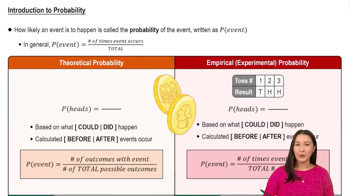
Introduction to Probability

Complementary Events

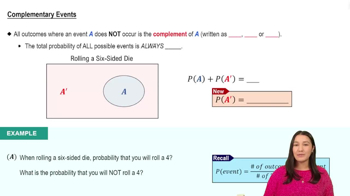
Complementary events are pairs of outcomes that cover all possible scenarios of a given situation. In this case, the event of having at least one girl is the complement of having no girls at all. By calculating the probability of the complementary event (having all boys), we can easily find the probability of having at least one girl by subtracting this value from 1.
Recommended video:
4:23
Complementary Events

Binomial Probability

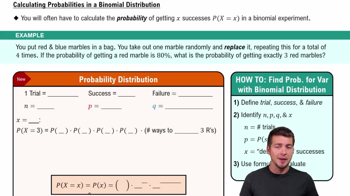
Binomial probability refers to the probability of obtaining a fixed number of successes in a fixed number of independent Bernoulli trials. In this scenario, each child can be considered a trial with two outcomes (boy or girl). The binomial formula can be used to calculate the probability of having a specific number of boys or girls among the three children, which is crucial for determining the probability of having at least one girl.
Recommended video:
Guided course
06:39
Calculating Probabilities in a Binomial Distribution
Related Practice
Textbook Question

Standard Tests Standard tests, such as the SAT or ACT or MCAT, tend to make extensive use of multiple-choice questions because they are easy to grade using software. If one such multiple choice question has possible correct answers of a, b, c, d, e, what is the probability of a wrong answer if the answer is a random guess?

Textbook Question

Florida Pick 3 In the Florida Pick 3 lottery, you can place a “straight” bet of \(1 by selecting the exact order of three digits between 0 and 9 inclusive (with repetition allowed), so the probability of winning is 1/1000. If the same three numbers are drawn in the same order, you collect \)500, so your net profit is \$499.


c. Is there much of a difference between the actual odds against winning and the payoff odds?

Textbook Question

Mega Millions As of this writing, the Mega Millions lottery is run in 44 states. Winning the jackpot requires that you select the correct five different numbers from 1 to 70 and, in a separate drawing, you must also select the correct single number from 1 to 25.


c. How does the probability compare to the probability for the old Mega Millions game which involved the selection of five different numbers between 1 and 75 and a separate single number between 1 and 15?

Textbook Question

Sampling Eye Color Based on a study by Dr. P. Sorita Soni at Indiana University, assume that eye colors in the United States are distributed as follows: 40% brown, 35% blue, 12% green, 7% gray, 6% hazel.


d. If two people are randomly selected, what is the probability that at least one of them has brown eyes?

Textbook Question

Subjective Probability Estimate the probability that the next time you watch a TV news report, it includes a story about a plane crash.

Textbook Question

In Exercises 6–10, use the following results from tests of an experiment to test the effectiveness of an experimental vaccine for children (based on data from USA Today). Express all probabilities in decimal form.


If 1 of the 1602 subjects is randomly selected, find the probability of getting 1 who had the vaccine treatment and developed flu.