Ch. 2 - Exploring Data with Tables and Graphs
Triola - Elementary Statistics 14th Edition
Triola14th EditionElementary StatisticsISBN: 9780137366446Not the one you use?Change textbook
Chapter 2, Problem 2.1.12

In Exercises 9–12, using a loose interpretation of the criteria for determining whether a frequency distribution is approximately a normal distribution, determine whether the given frequency distribution is approximately a normal distribution. Give a brief explanation.
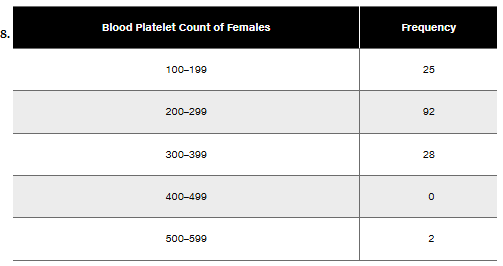
Blood Platelet Counts of Females Refer to the frequency distribution from Exercise 8

Verified step by step guidance
1
Step 1: Review the frequency distribution table provided. The table lists blood platelet counts of females in intervals (100–199, 200–299, etc.) along with their corresponding frequencies.
Step 2: Check for symmetry in the distribution. A normal distribution typically has frequencies that increase to a peak and then decrease symmetrically. Observe whether the frequencies rise to a peak and then fall off in a balanced manner.
Step 3: Identify the peak frequency. In this case, the interval 200–299 has the highest frequency (92). Compare the frequencies of intervals on either side of the peak to see if they decrease symmetrically.
Step 4: Look for gaps or irregularities. Note that the interval 400–499 has a frequency of 0, which disrupts the smooth decline expected in a normal distribution. This gap suggests the distribution may not be normal.
Step 5: Consider the shape of the distribution. Based on the frequencies, the distribution appears skewed rather than bell-shaped, as the frequencies do not decrease symmetrically around the peak. Provide an explanation that the distribution is not approximately normal due to the lack of symmetry and the presence of gaps.

Verified video answer for a similar problem:

This video solution was recommended by our tutors as helpful for the problem above.
Video duration:
2m
Was this helpful?

Key Concepts

Here are the essential concepts you must grasp in order to answer the question correctly.

Normal Distribution

A normal distribution is a probability distribution that is symmetric about the mean, showing that data near the mean are more frequent in occurrence than data far from the mean. It is characterized by its bell-shaped curve, where the mean, median, and mode are all equal. Understanding this concept is crucial for determining if a frequency distribution approximates normality.
Recommended video:
Guided course
03:17
Finding Z-Scores for Non-Standard Normal Variables

Frequency Distribution

A frequency distribution is a summary of how often each value occurs in a dataset. It displays the number of occurrences (frequency) of each category or range of values. Analyzing the frequency distribution helps in visualizing the data and assessing its shape, which is essential for evaluating whether it resembles a normal distribution.
Recommended video:
Guided course
06:38
Intro to Frequency Distributions

Criteria for Normality

The criteria for determining if a distribution is approximately normal include assessing the symmetry of the distribution, the presence of a single peak (unimodality), and the tails of the distribution. A common method is to use graphical representations like histograms or Q-Q plots, as well as statistical tests. These criteria help in making informed judgments about the normality of the data.
Recommended video:
Guided course
03:17
Finding Z-Scores for Non-Standard Normal Variables
Related Practice
Textbook Question

In Exercises 5 and 6, construct the dotplot.


Diastolic Blood Pressure Listed below are diastolic blood pressure measurements (mm Hg) of females selected from Data Set 1 “Body Data” in Appendix B. All of the values are even numbers. Are there any outliers? If so, identify their values.

Textbook Question

In Exercises 15 and 16, construct the frequency polygons.

Presidents Use the frequency distribution from Exercise 14 in Section 2-1 to construct a frequency polygon. Does the graph suggest that the distribution is skewed? If so, how?

1
views
Textbook Question

In Exercises 5–8, identify the class width, class midpoints, and class boundaries for the given frequency distribution. Also identify the number of individuals included in the summary. The frequency distributions are based on real data from Appendix B.

1
views
Textbook Question

Causation A study has shown that there is a correlation between body weight and blood pressure. Higher body weights are associated with higher blood pressure levels. Can we conclude that gaining weight is a cause of increased blood pressure?

Textbook Question

In Exercises 5–8, answer the questions by referring to the following Minitab-generated histogram, which depicts the weights (grams) of all quarters listed in Data Set 40 “Coin Weights” in Appendix B. (Grams are actually units of mass and the values shown on the horizontal scale are rounded.)

Class Width and Class Limits Give the approximate values of the class width, and the lower and upper class limits of the class depicted in the bar farthest to the left.

1
views
Textbook Question

In Exercises 5–8, answer the questions by referring to the following Minitab-generated histogram, which depicts the weights (grams) of all quarters listed in Data Set 40 “Coin Weights” in Appendix B. (Grams are actually units of mass and the values shown on the horizontal scale are rounded.)


Relative Frequency Histogram How would the shape of the histogram change if the vertical scale uses relative frequencies expressed in percentages instead of the actual frequency counts as shown here?