
Ch. 12 - Analysis of Variance
Triola - Elementary Statistics 14th Edition
Triola14th EditionElementary StatisticsISBN: 9780137366446Not the one you use?Change textbook
Chapter 12, Problem 12.2.6

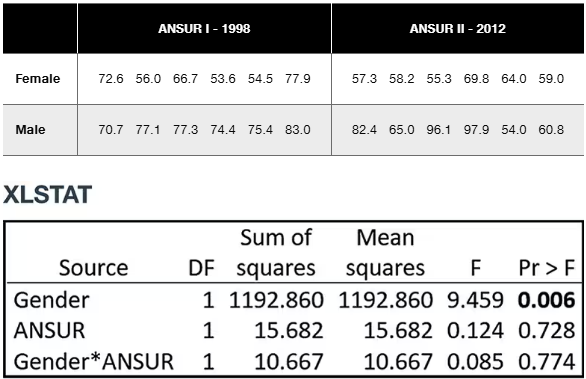
Weights from ANSUR I and ANSUR II The following table lists weights (kg) of randomly selected U.S. Army personnel obtained from the ANSUR I study conducted in 1988 and the ANSUR II study conducted in 2012. If we use the data with two-way analysis of variance and a 0.05 significance level, we get the accompanying display. What do you conclude?
Table showing weights in kg of male and female U.S. Army personnel from 1998 and 2012, with ANOVA results for gender and study.

Verified step by step guidance
1
Step 1: Identify the factors and levels in the two-way ANOVA. Here, the two factors are Gender (with levels Female and Male) and ANSUR Study (with levels 1998 and 2012). The response variable is the weight in kilograms.
Step 2: Examine the ANOVA table provided. The table shows degrees of freedom (DF), sum of squares, mean squares, F-statistics, and p-values (Pr > F) for each source of variation: Gender, ANSUR study, and their interaction (Gender*ANSUR).
Step 3: Interpret the p-values to determine statistical significance at the 0.05 significance level. For Gender, the p-value is 0.006, which is less than 0.05, indicating a significant effect of Gender on weight. For ANSUR study, the p-value is 0.728, which is greater than 0.05, indicating no significant effect of the study year on weight. For the interaction Gender*ANSUR, the p-value is 0.774, also greater than 0.05, indicating no significant interaction effect.
Step 4: Conclude that there is a statistically significant difference in weights between genders, but no significant difference between the two ANSUR studies (1998 vs 2012), and no significant interaction between Gender and ANSUR study.
Step 5: Summarize the findings by stating that weight differences are primarily explained by Gender, and the year of the ANSUR study does not significantly affect the weights measured.

Verified video answer for a similar problem:

This video solution was recommended by our tutors as helpful for the problem above.
Video duration:
4m
Was this helpful?

Key Concepts

Here are the essential concepts you must grasp in order to answer the question correctly.

Two-Way Analysis of Variance (ANOVA)

Two-way ANOVA is a statistical method used to examine the effect of two independent categorical variables on a continuous dependent variable. It also tests for interaction effects between the two factors, helping to determine if the effect of one factor depends on the level of the other.
Recommended video:
06:46
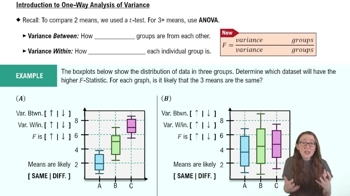
Introduction to ANOVA

F-Statistic and P-Value

The F-statistic measures the ratio of variance explained by the model to the unexplained variance. The p-value indicates the probability of observing the data if the null hypothesis is true. A p-value less than the significance level (e.g., 0.05) suggests rejecting the null hypothesis, indicating a significant effect.
Recommended video:
Guided course
06:50
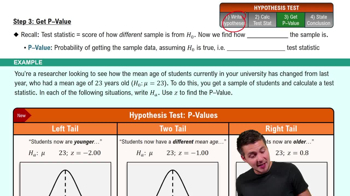
Step 3: Get P-Value

Interaction Effect in ANOVA

An interaction effect occurs when the effect of one independent variable on the dependent variable differs depending on the level of the other independent variable. In two-way ANOVA, testing the interaction helps understand if the combined factors influence the outcome differently than each factor alone.
Recommended video:
05:31
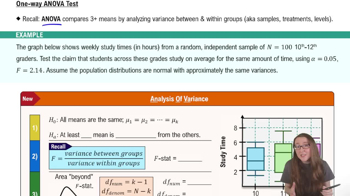
ANOVA Test
Related Practice
Textbook Question

In Exercises 5–16, use analysis of variance for the indicated test.


Triathlon Times Jeff Parent is a statistics instructor who participates in triathlons. Listed below are times (in minutes and seconds) he recorded while riding a bicycle for five stages through each mile of a 3-mile loop. Use a 0.05 significance level to test the claim that it takes the same time to ride each of the miles. Does one of the miles appear to have a hill?

Textbook Question

Two-Way Anova If we have a goal of using the data given in Exercise 1 to (1) determine whether the femur side (left, right) has an effect on the crash force measurements and (2) to determine whether the vehicle size has an effect on the crash force measurements, should we use one-way analysis of variance for the two individual tests? Why or why not?

Textbook Question

Distance Between Pupils The following table lists distances (mm) between pupils of randomly selected U.S. Army personnel collected as part of the ANSUR II study. Results from two-way analysis of variance are also shown. Use the displayed results and use a 0.05 significance level. What do you conclude? Are the results as you would expect?

Textbook Question

Tukey Test A display of the Bonferroni test results from Table 12-1 (which is part of the Chapter Problem) is provided here. Shown on the top of the next page is the SPSS-generated display of results from the Tukey test using the same data. Compare the Tukey test results to those from the Bonferroni test.

1
views
Textbook Question

Car Crash Test Measurements If we use the data given in Exercise 1 with two-way analysis of variance and a 0.05 significance level, we get the accompanying display. What do you conclude?

Textbook Question

Balanced Design Does the table given in Exercise 1 constitute a balanced design? Why or why not?