Ch. 12 - Analysis of Variance
Triola - Elementary Statistics 14th Edition
Triola14th EditionElementary StatisticsISBN: 9780137366446Not the one you use?Change textbook
Chapter 12, Problem 12.1.17

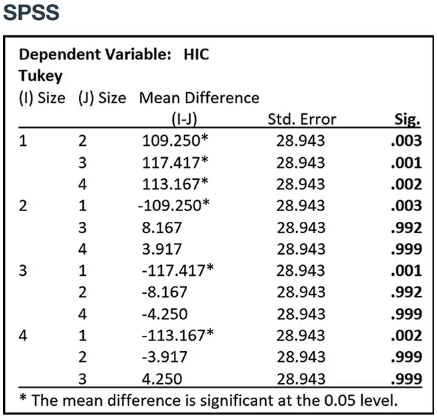
Tukey Test A display of the Bonferroni test results from Table 12-1 (which is part of the Chapter Problem) is provided here. Shown on the top of the next page is the SPSS-generated display of results from the Tukey test using the same data. Compare the Tukey test results to those from the Bonferroni test.
SPSS Tukey test results table showing mean differences, standard errors, and significance levels for multiple size comparisons.

Verified step by step guidance
1
Step 1: Understand the purpose of the Tukey test and Bonferroni test. Both are post-hoc multiple comparison tests used after an ANOVA to determine which specific group means differ significantly from each other while controlling for Type I error.
Step 2: Examine the Tukey test results table. Identify the pairs of group sizes compared (Size 1 vs 2, 1 vs 3, etc.), the mean differences between these groups, the standard error of the differences, and the significance values (p-values).
Step 3: Note that the asterisk (*) next to the mean difference indicates a statistically significant difference at the 0.05 level. For example, Size 1 vs Size 2 has a mean difference of 109.250 with a p-value of 0.003, which is significant.
Step 4: Compare these Tukey test results to the Bonferroni test results from Table 12-1 (not shown here). Look for similarities and differences in which group comparisons are significant and the magnitude of mean differences and p-values.
Step 5: Conclude by discussing how both tests control for multiple comparisons but may differ slightly in sensitivity. Tukey's test is generally more powerful when comparing all pairs, while Bonferroni is more conservative. Highlight any pairs that are significant in one test but not the other.

Verified video answer for a similar problem:

This video solution was recommended by our tutors as helpful for the problem above.
Video duration:
2m
Was this helpful?

Key Concepts

Here are the essential concepts you must grasp in order to answer the question correctly.

Multiple Comparison Tests

Multiple comparison tests are statistical procedures used after an ANOVA to determine which specific group means differ. They control the overall Type I error rate when making several pairwise comparisons. Examples include the Bonferroni and Tukey tests, each with different approaches to adjusting significance levels.
Recommended video:
08:22
Tukey Test

Tukey's Honestly Significant Difference (HSD) Test

Tukey's HSD test compares all possible pairs of group means while controlling the family-wise error rate. It uses a studentized range distribution to determine critical values, making it more powerful than Bonferroni when comparing many groups. Significant mean differences are marked with an asterisk in SPSS output.
Recommended video:
08:22
Tukey Test

Interpretation of SPSS Output for Multiple Comparisons

SPSS output for multiple comparisons includes mean differences, standard errors, and significance values (p-values). A significant result (p < 0.05) indicates a statistically meaningful difference between group means. The output helps identify which specific pairs differ, guiding conclusions about group effects.
Recommended video:
08:22
Tukey Test
Related Practice
Textbook Question

Weights from ANSUR I and ANSUR II The following table lists weights (kg) of randomly selected U.S. Army personnel obtained from the ANSUR I study conducted in 1988 and the ANSUR II study conducted in 2012. If we use the data with two-way analysis of variance and a 0.05 significance level, we get the accompanying display. What do you conclude?

Textbook Question

Distance Between Pupils The following table lists distances (mm) between pupils of randomly selected U.S. Army personnel collected as part of the ANSUR II study. Results from two-way analysis of variance are also shown. Use the displayed results and use a 0.05 significance level. What do you conclude? Are the results as you would expect?

Textbook Question

Pancake Experiment Listed below are ratings of pancakes made by experts (based on data from Minitab). Different pancakes were made with and without a supplement and with different amounts of whey. The results from two-way analysis of variance are shown. Use the displayed results and a 0.05 significance level. What do you conclude?

Textbook Question

Two-Way Anova The measurements of crash test forces on the femur in Table 12-3 from Example 1 are reproduced below with fabricated measurement data (in red) used for the left femur in a small car. What characteristic of the data suggests that the appropriate method of analysis is two-way analysis of variance? That is, what is “two-way” about the data entered in this table?

Textbook Question

Car Crash Test Measurements If we use the data given in Exercise 1 with two-way analysis of variance and a 0.05 significance level, we get the accompanying display. What do you conclude?

Textbook Question

In Exercises 1–4, use the following listed measured amounts of chest compression (mm) from car crash tests (from Data Set 35 “Car Data” in Appendix B). Also shown are the SPSS results from analysis of variance. Assume that we plan to use a 0.05 significance level to test the claim that the different car sizes have the same mean amount of chest compression.


Why Not Test Two at a Time? Refer to the sample data given in Exercise 1. If we want to test for equality of the four means, why don’t we use the methods of Section 9-2 “Two Means: Independent Samples” for the following six separate hypothesis tests?