Ch. 11 - Goodness-of-Fit and Contingency Tables
Triola - Elementary Statistics 14th Edition
Triola14th EditionElementary StatisticsISBN: 9780137366446Not the one you use?Change textbook
Chapter 11, Problem 11.1.25b

Testing Goodness-of-Fit with a Normal Distribution Refer to Data Set 1 “Body Data” in Appendix B for the heights of females.


<IMAGE>


b. Assuming a normal distribution with mean and standard deviation given by the sample mean and standard deviation, use the methods of Chapter 6 to find the probability of a randomly selected height belonging to each class.

Verified step by step guidance
1
Step 1: Identify the mean (μ) and standard deviation (σ) of the sample data provided in Data Set 1 'Body Data'. These values will be used to assume a normal distribution for the heights of females.
Step 2: For each height class (e.g., 'Less than 155.45', '155.45 - 162.05', etc.), calculate the z-scores using the formula: z=x-μσ, where x is the boundary value of the class, μ is the mean, and σ is the standard deviation.
Step 3: Use the z-scores to find the cumulative probabilities for each boundary value using the standard normal distribution table or a statistical software. For example, find P(Z < z) for the lower and upper bounds of each class.
Step 4: Calculate the probability for each class by subtracting the cumulative probability of the lower boundary from the cumulative probability of the upper boundary. For example, for the class '155.45 - 162.05', compute P(155.45 ≤ X ≤ 162.05) = P(Z < z_upper) - P(Z < z_lower).
Step 5: Verify that the sum of probabilities across all classes is approximately 1, as this confirms the probabilities align with the assumed normal distribution. If necessary, adjust for rounding errors.

Verified video answer for a similar problem:

This video solution was recommended by our tutors as helpful for the problem above.
Video duration:
8m
Was this helpful?

Key Concepts

Here are the essential concepts you must grasp in order to answer the question correctly.

Normal Distribution

Normal distribution is a continuous probability distribution characterized by its bell-shaped curve, defined by its mean and standard deviation. In this context, it is assumed that the heights of females follow this distribution, allowing for the application of statistical methods to analyze the data. The properties of normal distribution, such as symmetry and the empirical rule, are crucial for understanding how data is expected to behave.
Recommended video:
Guided course
09:47
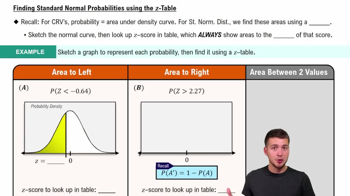
Finding Standard Normal Probabilities using z-Table

Goodness-of-Fit Test

A goodness-of-fit test assesses how well a statistical model fits a set of observations. In this case, it evaluates whether the observed frequencies of female heights align with the expected frequencies derived from the normal distribution. Common tests include the Chi-square test, which compares observed and expected frequencies to determine if there are significant deviations.
Recommended video:
Guided course
06:34
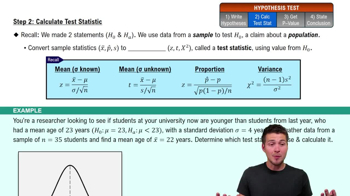
Step 2: Calculate Test Statistic

Probability and Class Intervals

Probability in this context refers to the likelihood of a randomly selected height falling within specified class intervals. The class intervals provided in the table categorize heights into ranges, and calculating the probability involves determining the proportion of the total sample that falls within each range. This is essential for interpreting the distribution of heights and understanding how they relate to the normal distribution.
Recommended video:
Guided course
09:00
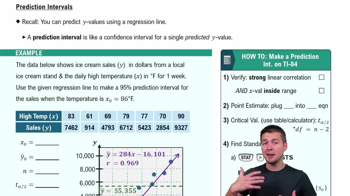
Prediction Intervals
Related Practice
Textbook Question

Testing Goodness-of-Fit with a Normal Distribution Refer to Data Set 1 “Body Data” in Appendix B for the heights of females.


" style="" width="600">


a. Enter the observed frequencies in the table above.

1
views

Textbook Question

Cybersecurity The table below lists the frequency of leading digits of Internet traffic interarrival times for a computer, along with the percentages of each leading digit expected with Benford’s law.


a. Identify the general notation used for observed and expected values.


" style="" width="650">

Textbook Question

Cybersecurity The table below lists the frequency of leading digits of Internet traffic interarrival times for a computer, along with the percentages of each leading digit expected with Benford’s law.


b. Identify the observed and expected values for the leading digit of 2.


" style="max-width: 100%; white-space-collapse: preserve;" width="650">

Textbook Question

Testing Goodness-of-Fit with a Normal Distribution Refer to Data Set 1 “Body Data” in Appendix B for the heights of females.


" style="max-width: 100%; white-space-collapse: preserve;" width="600">


c. Using the probabilities found in part (b), find the expected frequency for each category.

1
views
Textbook Question

Cybersecurity The table below lists the frequency of leading digits of Internet traffic interarrival times for a computer, along with the percentages of each leading digit expected with Benford’s law.


c. Use the results from part (b) to find the contribution to the x2 test statistic from the category representing the leading digit of 2.


" style="max-width: 100%; white-space-collapse: preserve;" width="650">

Textbook Question

Weather-Related Deaths For the most recent year as of this writing, the numbers of weather-related U.S. deaths for each month were 61, 14, 22, 26, 29, 42, 93, 49, 47, 35, 96, 16, listed in order beginning with January (based on data from the National Weather Service). Use a 0.01 significance level to test the claim that weather-related deaths occur in the different months with the same frequency. Provide an explanation for the result.