Ch. 10 - Correlation and Regression
Triola - Elementary Statistics 14th Edition
Triola14th EditionElementary StatisticsISBN: 9780137366446Not the one you use?Change textbook
Chapter 10, Problem 10.4.1

Response and Predictor Variables Using all of the Tour de France bicycle race results up to a recent year, we get this multiple regression equation: Speed = 29.2-0.00260Distance + 0.540Stages + 0.0570Finishers, where Speed is the mean speed of the winner (km/h), Distance is the length of the race (km), Stages is the number of stages in the race, and Finishers is the number of bicyclists who finished the race. Identify the response and predictor variables.

Verified step by step guidance
1
Understand the context of the problem: We are given a multiple regression equation that models the mean speed of the winner in the Tour de France based on several factors.
Identify the response variable: In a regression equation, the response variable is the dependent variable that we are trying to predict or explain. In this equation, 'Speed' is the response variable as it is the outcome we are modeling.
Identify the predictor variables: Predictor variables are the independent variables that are used to predict the response variable. In this equation, 'Distance', 'Stages', and 'Finishers' are the predictor variables.
Explain the role of each predictor variable: 'Distance' represents the length of the race, 'Stages' represents the number of stages in the race, and 'Finishers' represents the number of bicyclists who finished the race. Each of these variables contributes to predicting the 'Speed'.
Summarize the relationship: The equation suggests that 'Speed' is influenced by the 'Distance', 'Stages', and 'Finishers'. The coefficients indicate the expected change in 'Speed' for a one-unit change in each predictor variable, holding the others constant.

Verified video answer for a similar problem:

This video solution was recommended by our tutors as helpful for the problem above.
Video duration:
3m
Was this helpful?

Key Concepts

Here are the essential concepts you must grasp in order to answer the question correctly.

Response Variable

In regression analysis, the response variable, also known as the dependent variable, is the main factor being studied and predicted. It is the outcome that changes in response to the predictor variables. In the given equation, 'Speed' is the response variable, as it represents the mean speed of the winner, which is influenced by the other variables in the model.
Recommended video:
Guided course
07:09
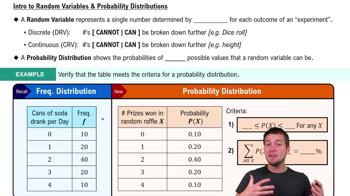
Intro to Random Variables & Probability Distributions

Predictor Variables

Predictor variables, also known as independent variables, are the factors that are used to predict or explain changes in the response variable. They are the inputs in a regression model. In the given equation, 'Distance', 'Stages', and 'Finishers' are the predictor variables, as they are used to estimate the mean speed of the winner in the Tour de France.
Recommended video:
Guided course
07:09
Intro to Random Variables & Probability Distributions

Multiple Regression

Multiple regression is a statistical technique used to model the relationship between a single response variable and two or more predictor variables. It allows for the assessment of the impact of each predictor on the response variable while controlling for the others. The given equation is an example of multiple regression, where the mean speed is modeled as a function of race distance, number of stages, and number of finishers.
Recommended video:
05:54
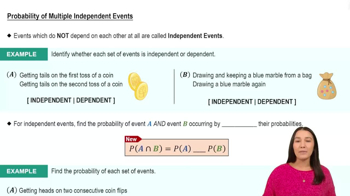
Probability of Multiple Independent Events
Related Practice
Textbook Question

Interpreting the Coefficient of Determination

In Exercises 5–8, use the value of the linear correlation coefficient r to find the coefficient of determination and the percentage of the total variation that can be explained by the linear relationship between the two variables.

Times of Taxi Rides and Tips r = 0.298 (x = time in minutes, y = the amount of tip in dollars)

Textbook Question

Regression and Predictions

Exercises 13–28 use the same data sets as Exercises 13–28 in Section 10-1.


Find the regression equation, letting the first variable be the predictor (x) variable.

Find the indicated predicted value by following the prediction procedure summarized in Figure 10-5.


Oscars Listed below are ages of recent Oscar winners matched by the years in which the awards were won (from Data Set 21 “Oscar Winner Age” in Appendix B). Find the best predicted age of an Oscar-winning actress given that the Oscar winner for best actor is 59 years of age. How does the result compare to the actual actress age of 60 years?


[IMAGE]

3
views
Textbook Question

Large Data Sets

Exercises 29–32 use the same Appendix B data sets as Exercises 29–32 in Section 10-1. In each case, find the regression equation, letting the first variable be the predictor (x) variable. Find the indicated predicted values following the prediction procedure summarized in Figure 10-5.

Taxis Repeat Exercise 15 using all of the time/tip data from the 703 taxi rides listed in Data Set 32 “Taxis” from Appendix B.

3
views
Textbook Question

Regression and Predictions

Exercises 13–28 use the same data sets as Exercises 13–28 in Section 10-1.


Find the regression equation, letting the first variable be the predictor (x) variable.

Find the indicated predicted value by following the prediction procedure summarized in Figure 10-5.


Powerball Jackpots and Tickets Sold Listed below are the same data from Table 10-1 in the Chapter Problem, but an additional pair of values has been added from actual Powerball results. (Jackpot amounts are in millions of dollars, ticket sales are in millions.) Find the best predicted number of tickets sold when the jackpot was actually 345 million dollars. How does the result compare to the value of 55 million tickets that were actually sold?


Textbook Question

Regression and Predictions

Exercises 13–28 use the same data sets as Exercises 13–28 in Section 10-1.


Find the regression equation, letting the first variable be the predictor (x) variable.

Find the indicated predicted value by following the prediction procedure summarized in Figure 10-5.

Subway and the CPI Use the subway/CPI data from the preceding exercise. What is the best predicted value of the CPI when the subway fare is \$3.00?

3
views
Textbook Question

Finding the Equation of the Regression Line

In Exercises 9 and 10, use the given data to find the equation of the regression line. Examine the scatterplot and identify a characteristic of the data that is ignored by the regression line.


[IMAGE]

4
views