Ch. 10 - Correlation and Regression
Triola - Elementary Statistics 14th Edition
Triola14th EditionElementary StatisticsISBN: 9780137366446Not the one you use?Change textbook
Chapter 10, Problem 10.3.5

Interpreting the Coefficient of Determination
In Exercises 5–8, use the value of the linear correlation coefficient r to find the coefficient of determination and the percentage of the total variation that can be explained by the linear relationship between the two variables.
Times of Taxi Rides and Tips r = 0.298 (x = time in minutes, y = the amount of tip in dollars)

Verified step by step guidance
1
Step 1: Recall the formula for the coefficient of determination (R²), which is the square of the linear correlation coefficient r. The formula is R² = r².
Step 2: Substitute the given value of r (0.298) into the formula. This means you will calculate R² = (0.298)².
Step 3: Interpret the coefficient of determination (R²). It represents the proportion of the total variation in the dependent variable (y, the amount of tip in dollars) that can be explained by the linear relationship with the independent variable (x, time in minutes).
Step 4: To express this as a percentage, multiply the value of R² by 100. This will give you the percentage of the total variation in tips that can be explained by the time of the taxi ride.
Step 5: Conclude that the remaining percentage (100% - R²%) represents the variation in tips that cannot be explained by the linear relationship with time and may be due to other factors or randomness.

Verified video answer for a similar problem:

This video solution was recommended by our tutors as helpful for the problem above.
Video duration:
2m
Was this helpful?

Key Concepts

Here are the essential concepts you must grasp in order to answer the question correctly.

Coefficient of Determination (R²)

The coefficient of determination, denoted as R², quantifies the proportion of variance in the dependent variable that can be explained by the independent variable in a regression model. It ranges from 0 to 1, where 0 indicates no explanatory power and 1 indicates perfect explanation. In this context, R² is calculated as the square of the correlation coefficient (r), providing insight into the strength of the linear relationship between the two variables.
Recommended video:
Guided course
05:43
Correlation Coefficient

Linear Correlation Coefficient (r)

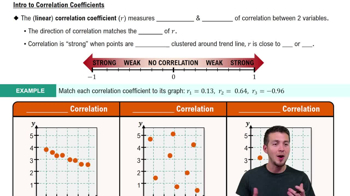
The linear correlation coefficient, represented as r, measures the strength and direction of a linear relationship between two variables. Its value ranges from -1 to 1, where values close to 1 indicate a strong positive correlation, values close to -1 indicate a strong negative correlation, and values around 0 suggest no linear correlation. In the given example, r = 0.298 indicates a weak positive correlation between taxi ride times and tips.
Recommended video:
Guided course
05:43
Correlation Coefficient

Total Variation

Total variation refers to the overall variability present in a dataset, which can be partitioned into explained variation and unexplained variation. In the context of regression analysis, explained variation is the portion of total variation that is accounted for by the model, while unexplained variation is the portion that remains after fitting the model. Understanding total variation is crucial for interpreting R², as it provides a baseline for assessing how well the model captures the data's variability.
Recommended video:
Guided course
08:45
Calculating Standard Deviation
Related Practice
Textbook Question

Moore’s Law In 1965, Intel cofounder Gordon Moore initiated what has since become known as Moore’s law: The number of transistors per square inch on integrated circuits will double approximately every 18 months. In the table below, the first row lists different years and the second row lists the number of transistors (in thousands) for different years.

Ignoring the listed data and assuming that Moore’s law is correct and transistors per square inch double every 18 months, which mathematical model best describes this law: linear, quadratic, logarithmic, exponential, power? What specific function describes Moore’s law?

Which mathematical model best fits the listed sample data?

Compare the results from parts (a) and (b). Does Moore’s law appear to be working reasonably well?

1
views
Textbook Question

Large Data Sets

Exercises 29–32 use the same Appendix B data sets as Exercises 29–32 in Section 10-1. In each case, find the regression equation, letting the first variable be the predictor (x) variable. Find the indicated predicted values following the prediction procedure summarized in Figure 10-5.

Taxis Repeat Exercise 16 using all of the distance/tip data from the 703 taxi rides listed in Data Set 32 “Taxis” from Appendix B.

3
views
Textbook Question

Regression and Predictions

Exercises 13–28 use the same data sets as Exercises 13–28 in Section 10-1.


Find the regression equation, letting the first variable be the predictor (x) variable.

Find the indicated predicted value by following the prediction procedure summarized in Figure 10-5.


Oscars Listed below are ages of recent Oscar winners matched by the years in which the awards were won (from Data Set 21 “Oscar Winner Age” in Appendix B). Find the best predicted age of an Oscar-winning actress given that the Oscar winner for best actor is 59 years of age. How does the result compare to the actual actress age of 60 years?


[IMAGE]

3
views
Textbook Question

Large Data Sets

Exercises 29–32 use the same Appendix B data sets as Exercises 29–32 in Section 10-1. In each case, find the regression equation, letting the first variable be the predictor (x) variable. Find the indicated predicted values following the prediction procedure summarized in Figure 10-5.

Taxis Repeat Exercise 15 using all of the time/tip data from the 703 taxi rides listed in Data Set 32 “Taxis” from Appendix B.

3
views
Textbook Question

Response and Predictor Variables Using all of the Tour de France bicycle race results up to a recent year, we get this multiple regression equation: Speed = 29.2-0.00260Distance + 0.540Stages + 0.0570Finishers, where Speed is the mean speed of the winner (km/h), Distance is the length of the race (km), Stages is the number of stages in the race, and Finishers is the number of bicyclists who finished the race. Identify the response and predictor variables.

3
views
Textbook Question

Correlation and Slope What is the relationship between the linear correlation coefficient r and the slope b1 of a regression line?