Ch. 10 - Correlation and Regression
Triola - Elementary Statistics 14th Edition
Triola14th EditionElementary StatisticsISBN: 9780137366446Not the one you use?Change textbook
Chapter 10, Problem 10.CQQ.8

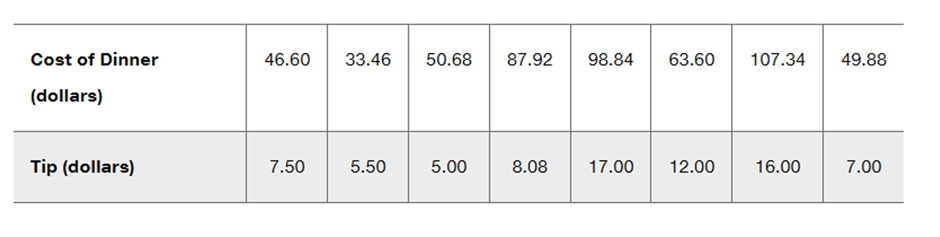
Exercises 1–10 are based on the following sample data consisting of costs of dinner (dollars) and the amounts of tips (dollars) left by diners. The data were collected by students of the author.
Table displaying costs of dinner and corresponding tips in dollars, with values for ten different diners.
Predictions The sample data result in a linear correlation coefficient of r = 0.846 and the regression equation y^ = -0.00777 + 0.145x. What is the best predicted amount of tip, given that the cost of dinner was \$84.62? How was the predicted value found?

Verified step by step guidance
1
Step 1: Understand the problem. We are tasked with predicting the tip amount based on the cost of dinner using the given regression equation y^ = -0.00777 + 0.145x, where x represents the cost of dinner and y^ represents the predicted tip amount.
Step 2: Identify the given values. The cost of dinner is provided as \$84.62. This value will be substituted into the regression equation to calculate the predicted tip amount.
Step 3: Substitute the cost of dinner (x = 84.62) into the regression equation. The equation becomes y^ = -0.00777 + 0.145(84.62).
Step 4: Perform the multiplication first. Multiply 0.145 by 84.62 to find the contribution of the dinner cost to the tip prediction.
Step 5: Add the result of the multiplication to -0.00777 to complete the calculation of the predicted tip amount. This will yield the final predicted value.

Verified video answer for a similar problem:

This video solution was recommended by our tutors as helpful for the problem above.
Video duration:
2m
Was this helpful?

Key Concepts

Here are the essential concepts you must grasp in order to answer the question correctly.

Linear Correlation Coefficient

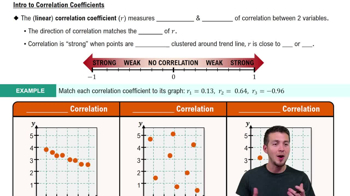
The linear correlation coefficient, denoted as 'r', measures the strength and direction of a linear relationship between two variables. Values range from -1 to 1, where 1 indicates a perfect positive correlation, -1 indicates a perfect negative correlation, and 0 indicates no correlation. In this case, an r value of 0.846 suggests a strong positive correlation between the cost of dinner and the amount of tip left.
Recommended video:
Guided course
05:43
Correlation Coefficient

Regression Equation

A regression equation describes the relationship between an independent variable (x) and a dependent variable (y). The equation provided, y^ = -0.00777 + 0.145x, allows us to predict the value of y (tip) based on a given value of x (cost of dinner). The slope (0.145) indicates how much the tip is expected to increase for each additional dollar spent on dinner.
Recommended video:
Guided course
08:45
Calculating Standard Deviation

Prediction Using Regression

To predict the amount of tip based on the cost of dinner, we substitute the given cost into the regression equation. For a dinner cost of $84.62, we calculate y^ by plugging this value into the equation, yielding the best predicted tip amount. This process illustrates how regression analysis can be used to make informed predictions based on observed data.
Recommended video:
06:23
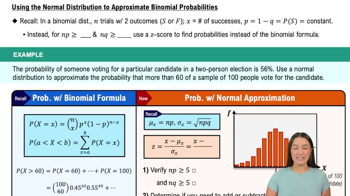
Using the Normal Distribution to Approximate Binomial Probabilities
Related Practice
Textbook Question

Time and Motion In a physics experiment at Doane College, a soccer ball was thrown upward from the bed of a moving truck. The table below lists the time (sec) that has lapsed from the throw and the corresponding height (m) of the soccer ball.

[IMAGE]

a. Find the value of the linear correlation coefficient r.

4
views
Textbook Question

Exercises 1–10 are based on the following sample data consisting of costs of dinner (dollars) and the amounts of tips (dollars) left by diners. The data were collected by students of the author.

[IMAGE]

Scatterplot Construct a scatterplot and comment on the pattern of points.

5
views
Textbook Question

Exercises 1–10 are based on the following sample data consisting of costs of dinner (dollars) and the amounts of tips (dollars) left by diners. The data were collected by students of the author.

[IMAGE]

Change in Scale Exercise 1 stated that for the given paired data, r = 0.846. How does that value change if all of the amounts of dinners are left unchanged but all of the tips are expressed in cents instead of dollars?

4
views
Textbook Question

Notation The author conducted an experiment in which the height of each student was measured in centimeters and those heights were matched with the same students’ scores on the first statistics test. If we find that r = 0, does that indicate that there is no association between those two variables?

3
views
Textbook Question

Casino Size and Revenue Use the same paired data from the preceding exercise.

b. What is the best predicted amount of revenue for a casino with a size of 200 thousand square feet? Is it likely that the best predicted amount of revenue will be accurate?


Textbook Question

Exercises 1–10 are based on the following sample data consisting of costs of dinner (dollars) and the amounts of tips (dollars) left by diners. The data were collected by students of the author.

[IMAGE]

Fixed Percentage If a restaurant were to change its tipping policy so that a constant tip of 20% of the bill is added to the cost of the dinner, what would be the value of the linear correlation coefficient for the paired amounts of dinners/tips?

4
views