Ch. 10 - Correlation and Regression
Triola - Elementary Statistics 14th Edition
Triola14th EditionElementary StatisticsISBN: 9780137366446Not the one you use?Change textbook
Chapter 10, Problem 10.1.29

Appendix B Data Sets
In Exercises 29–32, use the data from Appendix B to construct a scatterplot, find the value of the linear correlation coefficient r, and find either the P-value or the critical values of r from Table A-6 using a significance level of α = 0.05. Determine whether there is sufficient evidence to support the claim of a linear correlation between the two variables.
Taxis Repeat Exercise 15 using all of the time/tip data from the 703 taxi rides listed in Data Set 32 “Taxis” from Appendix B. Compare the results to those found in Exercise 15.

Verified step by step guidance
1
Step 1: Extract the data for time and tip from Data Set 32 'Taxis' in Appendix B. Ensure you have all 703 data points for the analysis.
Step 2: Construct a scatterplot by plotting the time (independent variable) on the x-axis and the tip (dependent variable) on the y-axis. This will help visualize the relationship between the two variables.
Step 3: Calculate the linear correlation coefficient (r) using the formula: r = (Σ((x - x̄)(y - ȳ))) / (sqrt(Σ(x - x̄)^2) * sqrt(Σ(y - ȳ)^2)), where x̄ and ȳ are the means of the time and tip data, respectively.
Step 4: Determine the critical values of r from Table A-6 for a significance level of α = 0.05 and the appropriate degrees of freedom (df = n - 2, where n is the number of data points). Alternatively, calculate the P-value for the observed r.
Step 5: Compare the calculated r value to the critical values or the P-value to α. If |r| > critical value or P-value < α, conclude that there is sufficient evidence to support the claim of a linear correlation. Otherwise, conclude that there is insufficient evidence. Finally, compare these results to those found in Exercise 15 to identify any differences or similarities.

Verified video answer for a similar problem:

This video solution was recommended by our tutors as helpful for the problem above.
Video duration:
3m
Was this helpful?

Key Concepts

Here are the essential concepts you must grasp in order to answer the question correctly.

Scatterplot

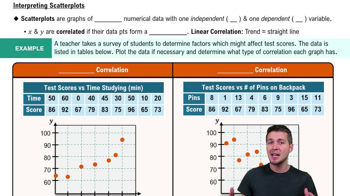
A scatterplot is a graphical representation of two variables, where each point represents an observation in the dataset. It helps visualize the relationship between the variables, indicating whether a correlation exists. The pattern of the points can suggest the strength and direction of the relationship, making it a fundamental tool in exploratory data analysis.
Recommended video:
Guided course
06:36
Scatterplots & Intro to Correlation

Linear Correlation Coefficient (r)

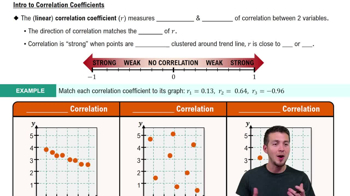
The linear correlation coefficient, denoted as r, quantifies the strength and direction of a linear relationship between two variables. Its value ranges from -1 to 1, where 1 indicates a perfect positive correlation, -1 indicates a perfect negative correlation, and 0 indicates no correlation. Understanding r is crucial for assessing the degree of association between the variables in the dataset.
Recommended video:
Guided course
05:43
Correlation Coefficient

P-value and Significance Level

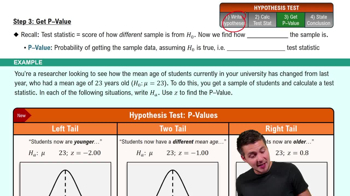
The P-value is a statistical measure that helps determine the significance of results in hypothesis testing. It indicates the probability of observing the data, or something more extreme, if the null hypothesis is true. A significance level (α), often set at 0.05, is the threshold for deciding whether to reject the null hypothesis, providing a basis for concluding whether a linear correlation is statistically significant.
Recommended video:
Guided course
06:50
Step 3: Get P-Value
Related Practice
Textbook Question

Regression and Predictions

Exercises 13–28 use the same data sets as Exercises 13–28 in Section 10-1.


Find the regression equation, letting the first variable be the predictor (x) variable.

Find the indicated predicted value by following the prediction procedure summarized in Figure 10-5.

Cars Sales and the Super Bowl Listed below are the annual numbers of cars sold (thousands) and the numbers of points scored in the Super Bowl that same year. What is the best predicted number of Super Bowl points in a year with sales of 8423 thousand cars? How close is the predicted number to the actual result of 37 points?


[IMAGE]

3
views
Textbook Question

Interpreting a Computer Display

In Exercises 9–12, refer to the display obtained by using the paired data consisting of weights (pounds) and highway fuel consumption amounts (mi/gal) of the large cars included in Data Set 35 “Car Data” in Appendix B. Along with the paired weights and fuel consumption amounts, StatCrunch was also given the value of 4000 pounds to be used for predicting highway fuel consumption.

Finding a Prediction Interval For a car weighing 4000 pounds (x = 4000) identify the 95% prediction interval estimate of the highway fuel consumption. Write a statement interpreting that interval.

1
views
Textbook Question

Regression and Predictions

Exercises 13–28 use the same data sets as Exercises 13–28 in Section 10-1.


Find the regression equation, letting the first variable be the predictor (x) variable.

Find the indicated predicted value by following the prediction procedure summarized in Figure 10-5.


Taxis Use the distance/fare data from Exercise 15 and find the best predicted fare amount for a distance of 3.10 miles. How does the result compare to the actual fare of \$15.30?

Textbook Question

Best-Fit Line


What is a residual?

In what sense is the regression line the straight line that “best” fits the points in a scatterplot?

Textbook Question

Interpreting a Computer Display

In Exercises 9–12, refer to the display obtained by using the paired data consisting of weights (pounds) and highway fuel consumption amounts (mi/gal) of the large cars included in Data Set 35 “Car Data” in Appendix B. Along with the paired weights and fuel consumption amounts, StatCrunch was also given the value of 4000 pounds to be used for predicting highway fuel consumption.


Testing for Correlation Use the information provided in the display to determine the value of the linear correlation coefficient. Is there sufficient evidence to support a claim of a linear correlation between weights of large cars and the highway fuel consumption amounts?

Textbook Question

Interpreting a Computer Display

In Exercises 9–12, refer to the display obtained by using the paired data consisting of weights (pounds) and highway fuel consumption amounts (mi/gal) of the large cars included in Data Set 35 “Car Data” in Appendix B. Along with the paired weights and fuel consumption amounts, StatCrunch was also given the value of 4000 pounds to be used for predicting highway fuel consumption.


[IMAGE]


Predicting Highway Fuel Consumption Using a car weight of x = 4000 (pounds), what is the single value that is the best predicted amount of highway fuel consumption?