Ch. 1 - Introduction to Statistics
Triola - Elementary Statistics 14th Edition
Triola14th EditionElementary StatisticsISBN: 9780137366446Not the one you use?Change textbook
Chapter 1, Problem 1.1.28

In Exercises 25–28, refer to the data in the table below. The entries are for five different years, and they consist of weights (metric tons) of lemons imported from Mexico and U.S. car crash fatality rates per 100,000 population [based on data from “The Trouble with QSAR (or How I Learned to Stop Worrying and Embrace Fallacy)” by Stephen Johnson, Journal of Chemical Information and Modeling, Vol. 48, No. 1].
[IMAGE]
Conclusion If we were to use the sample data and conclude that there is a correlation or association between lemon imports and crash fatality rates, does it follow that lemon imports are the cause of fatal crashes?

Verified step by step guidance
1
Step 1: Understand the problem. The question is asking whether a correlation or association between two variables (lemon imports and car crash fatality rates) implies causation. This is a common statistical concept where correlation does not necessarily mean causation.
Step 2: Define the key terms. Correlation refers to a statistical relationship between two variables, which can be positive, negative, or zero. Causation, on the other hand, implies that one variable directly affects the other. It is important to distinguish between these two concepts.
Step 3: Analyze the data. Look at the data provided in the table. Calculate the correlation coefficient (r) to determine the strength and direction of the relationship between lemon imports and car crash fatality rates. Use the formula for Pearson's correlation coefficient: r=(x-)(y-)((x-))2((y-))2. Here, x and y represent the two variables, and x̄ and ȳ are their respective means.
Step 4: Interpret the correlation coefficient. If the correlation coefficient is close to 1 or -1, it indicates a strong relationship. If it is close to 0, it indicates a weak or no relationship. However, even if a strong correlation exists, it does not imply causation. Other factors, such as confounding variables, could be influencing the relationship.
Step 5: Draw a conclusion. Based on the statistical analysis and the concept of correlation versus causation, explain that even if a correlation is found between lemon imports and car crash fatality rates, it does not mean that lemon imports cause fatal crashes. This could be an example of a spurious correlation, where two variables appear to be related but are not causally connected.

Verified video answer for a similar problem:

This video solution was recommended by our tutors as helpful for the problem above.
Video duration:
3m
Was this helpful?

Key Concepts

Here are the essential concepts you must grasp in order to answer the question correctly.

Correlation vs. Causation

Correlation refers to a statistical relationship between two variables, indicating that they tend to move together. However, this does not imply that one variable causes the other. Understanding this distinction is crucial, as it helps prevent erroneous conclusions about the nature of the relationship, especially in observational data where confounding factors may be present.
Recommended video:
Guided course
06:36
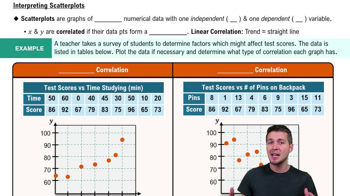
Scatterplots & Intro to Correlation

Confounding Variables

Confounding variables are external factors that may influence both the independent and dependent variables, potentially leading to misleading interpretations of data. In the context of the question, other factors could affect both lemon imports and car crash fatality rates, making it essential to identify and control for these variables to draw valid conclusions.
Recommended video:
Guided course
07:09
Intro to Random Variables & Probability Distributions

Statistical Significance

Statistical significance assesses whether the observed relationship in data is likely due to chance. A statistically significant result suggests that the correlation observed is unlikely to have occurred randomly. However, it is important to remember that statistical significance does not imply practical significance or causation, which must be evaluated through further analysis.
Recommended video:
Guided course
05:53
Parameters vs. Statistics
Related Practice
Textbook Question

E-Cigarette Survey In a survey of 36,000 adults, 3.7% said that they regularly use E-cigarettes (based on data from the National Center for Health Statistics)


b. Is the value of 3.7% a statistic or parameter?

1
views
Textbook Question

In Exercises 13–20, determine whether the data are from a discrete or continuous data set.

Fraud Detection While monitoring Internet traffic in order to detect fraudulent activity, a researcher records the interarrival times (sec) between incoming Internet queries.

1
views
Textbook Question

Quantitative/Categorical Data Identify each of the following as quantitative data or categorical data.


a. The platelet counts in Data Set 1 “Body Data” in Appendix B

1
views
Textbook Question

In Exercises 9–12, determine whether the sampling method appears to be sound or is flawed.


Nuclear Power Plants In a survey of 1368 subjects, the following question was posted on the USA Today website: “In your view, are nuclear plants safe?” The survey subjects were Internet users who chose to respond to the question posted on the electronic edition of USA Today.

2
views
Textbook Question

In Exercises 21–24, refer to the sample of body temperatures (degrees Fahrenheit) in the table below. (The body temperatures are from Data Set 5 in Appendix B.)

[IMAGE]

Conclusion Given the body temperatures in the table, what issue can be addressed by conducting a statistical analysis of the data?

1
views
Textbook Question

In Exercises 33–36, identify which of these designs is most appropriate for the given experiment: completely randomized design, randomized block design, or matched pairs design.


Lunesta Lunesta is a drug designed to treat insomnia. In a clinical trial of Lunesta, amounts of sleep each night are measured before and after subjects have been treated with the drug.

2
views