Ch. 1 - Introduction to Statistics
Triola - Elementary Statistics 14th Edition
Triola14th EditionElementary StatisticsISBN: 9780137366446Not the one you use?Change textbook
Chapter 1, Problem 1.2.4.2

E-Cigarette Survey In a survey of 36,000 adults, 3.7% said that they regularly use E-cigarettes (based on data from the National Center for Health Statistics)


b. Is the value of 3.7% a statistic or parameter?

Verified step by step guidance
1
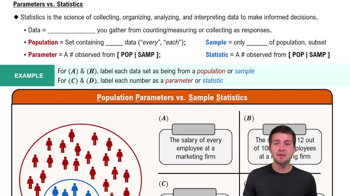
Understand the difference between a statistic and a parameter: A statistic is a numerical measurement describing some characteristic of a sample, while a parameter is a numerical measurement describing some characteristic of a population.
Identify the group being referred to in the problem: The problem mentions a survey of 36,000 adults, which is a sample of the larger population of all adults.
Determine what the 3.7% represents: The 3.7% is the proportion of the sample (36,000 adults) who said they regularly use E-cigarettes.
Since the 3.7% is derived from a sample (36,000 adults) and not the entire population of all adults, it is a statistic.
Conclude that the value of 3.7% is a statistic because it describes a characteristic of a sample, not the entire population.

Verified video answer for a similar problem:

This video solution was recommended by our tutors as helpful for the problem above.
Video duration:
1m
Was this helpful?

Key Concepts

Here are the essential concepts you must grasp in order to answer the question correctly.

Statistic vs. Parameter

A statistic is a numerical value that describes a characteristic of a sample, while a parameter is a numerical value that describes a characteristic of a population. In this context, the 3.7% figure represents the proportion of E-cigarette users among the surveyed adults, making it a statistic since it is derived from a sample of the larger population.
Recommended video:
Guided course
05:53
Parameters vs. Statistics

Sample Size

Sample size refers to the number of observations or data points collected in a survey or study. A larger sample size, like the 36,000 adults in this survey, generally leads to more reliable and valid results, reducing the margin of error and increasing the confidence in the findings about the population.
Recommended video:
05:11
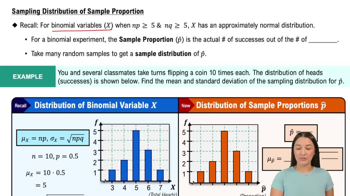
Sampling Distribution of Sample Proportion

Descriptive Statistics

Descriptive statistics are methods for summarizing and organizing data to provide a clear overview of its main features. The 3.7% figure is an example of descriptive statistics, as it summarizes the proportion of E-cigarette users in the sample, allowing for easy interpretation of the data without making inferences about the entire population.
Recommended video:
Guided course
05:53
Parameters vs. Statistics
Related Practice
Textbook Question

In Exercises 5–8, determine whether the given source has the potential to create a bias in a statistical study.


AAA The American Automobile Association (AAA) is a not-for-profit federation of motor clubs that provides automotive and travel services. AAA conducts a survey of its members about their use of public transportation versus private automobiles.

1
views
Textbook Question

In Exercises 13–20, determine whether the data are from a discrete or continuous data set.

Fraud Detection While monitoring Internet traffic in order to detect fraudulent activity, a researcher records the interarrival times (sec) between incoming Internet queries.

1
views
Textbook Question

In Exercises 25–28, refer to the data in the table below. The entries are for five different years, and they consist of weights (metric tons) of lemons imported from Mexico and U.S. car crash fatality rates per 100,000 population [based on data from “The Trouble with QSAR (or How I Learned to Stop Worrying and Embrace Fallacy)” by Stephen Johnson, Journal of Chemical Information and Modeling, Vol. 48, No. 1].

[IMAGE]

Conclusion If we were to use the sample data and conclude that there is a correlation or association between lemon imports and crash fatality rates, does it follow that lemon imports are the cause of fatal crashes?

1
views
Textbook Question

Quantitative/Categorical Data Identify each of the following as quantitative data or categorical data.


a. The platelet counts in Data Set 1 “Body Data” in Appendix B

1
views
Textbook Question

In Exercises 9–12, determine whether the sampling method appears to be sound or is flawed.


Nuclear Power Plants In a survey of 1368 subjects, the following question was posted on the USA Today website: “In your view, are nuclear plants safe?” The survey subjects were Internet users who chose to respond to the question posted on the electronic edition of USA Today.

2
views
Textbook Question

In Exercises 33–36, identify which of these designs is most appropriate for the given experiment: completely randomized design, randomized block design, or matched pairs design.


Lunesta Lunesta is a drug designed to treat insomnia. In a clinical trial of Lunesta, amounts of sleep each night are measured before and after subjects have been treated with the drug.

2
views