
Ch. 9 - Correlation and Regression
Larson - Elementary Statistics: Picturing the World 8th Edition
Larson8th EditionElementary Statistics: Picturing the WorldISBN: 9780137493470Not the one you use?Change textbook
Chapter 9, Problem 9.R.17

"In Exercises 17 and 18, use the data to (a) find the coefficient of determination r^2 and interpret
the result, and (b) find the standard error of estimate s_e and interpret the result.
17. The table shows the times (in seconds) to accelerate from 0 to 60 miles per hour and the top speeds (in miles per hour) for eight electric cars. The regression equation is y =- 14.399x + 196.996. (Source: Car and Driver)
Table displaying acceleration times and top speeds for eight electric cars, with data for analysis.

Verified step by step guidance
1
Step 1: Calculate the coefficient of determination, r². This is done by squaring the correlation coefficient r, which measures the strength and direction of the linear relationship between the acceleration time (x) and the top speed (y). If r is not given, you can calculate it using the formula r = (S_xy) / (sqrt(S_xx * S_yy)), where S_xy is the sum of the products of deviations, S_xx is the sum of squared deviations of x, and S_yy is the sum of squared deviations of y.
Step 2: Interpret the coefficient of determination r². This value represents the proportion of the variance in the dependent variable (top speed, y) that is predictable from the independent variable (acceleration time, x). For example, an r² of 0.85 means 85% of the variation in top speed can be explained by the acceleration time.
Step 3: Calculate the standard error of estimate, s_e. Use the formula se = \(\sqrt{\frac{\sum (y_i - \hat{y}\)_i)^2}{n - 2}}, where y_i are the observed values, \(\hat{y}\)_i are the predicted values from the regression equation y = -14.399x + 196.996, and n is the number of data points (8 in this case).
Step 4: Interpret the standard error of estimate s_e. This value measures the average distance that the observed values fall from the regression line. A smaller s_e indicates that the data points are closer to the regression line, meaning better predictive accuracy.
Step 5: Summarize your findings by explaining how well the regression model fits the data based on r² and s_e, and what this implies about the relationship between acceleration time and top speed for these electric cars.

Verified video answer for a similar problem:

This video solution was recommended by our tutors as helpful for the problem above.
Video duration:
3m
Was this helpful?

Key Concepts

Here are the essential concepts you must grasp in order to answer the question correctly.

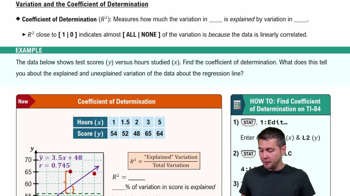
Coefficient of Determination (r²)

The coefficient of determination, r², measures the proportion of the variance in the dependent variable (top speed) that is predictable from the independent variable (acceleration time). It ranges from 0 to 1, where a higher value indicates a better fit of the regression model to the data. For example, an r² of 0.85 means 85% of the variation in top speed is explained by acceleration time.
Recommended video:
Guided course
06:14
Coefficient of Determination

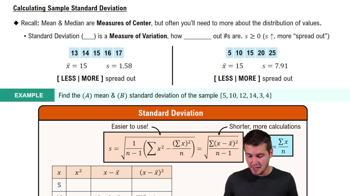
Standard Error of Estimate (sₑ)

The standard error of estimate quantifies the average distance that the observed values fall from the regression line. It measures the accuracy of predictions made by the regression equation, with smaller values indicating more precise predictions. It is calculated using the residuals, which are the differences between observed and predicted values.
Recommended video:
Guided course
08:45
Calculating Standard Deviation

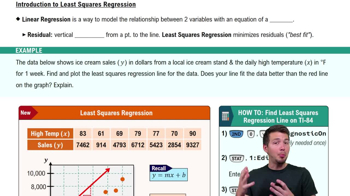
Linear Regression Equation

A linear regression equation models the relationship between an independent variable (x) and a dependent variable (y) using a straight line, expressed as y = mx + b. Here, y = -14.399x + 196.996 predicts top speed based on acceleration time. The slope (-14.399) shows the expected change in top speed for each additional second in acceleration time.
Recommended video:
Guided course
07:01
Intro to Least Squares Regression
Related Practice
Textbook Question

"In Exercises 27 and 28, use the multiple regression equation to predict the y-values for the values of the independent variables.

28. Use the regression equation found in Exercise 25.

a. x_1 = 9.0, x_2 = 0.70

b. x_1 = 3.0, x_2 = 0.25

c. x_1 = 8.0, x_2 = 0.60

d. x_1 = 5.2, x_2 = 0.46"

Textbook Question

"In Exercises 19-24, construct the indicated prediction interval and interpret the results.

22. Construct a 95% prediction interval for the fuel efficiency of an automobile in Exercise 12 that has an engine displacement of 265 cubic inches."

Textbook Question

"In Exercises 13-16, use the value of the correlation coefficient r to calculate the coefficient of determination r^2. What does this tell you about the explained variation of the data about the regression line? about the unexplained variation?

14.r =- 0.937"

Textbook Question

"In Exercises 19-24, construct the indicated prediction interval and interpret the results.

20. Construct a 90% prediction interval for the average time adults ages 35 to 44 spend per day watching television in Exercise 10 when the average time adults ages 25 to 34 spend per day watching television is 2.25 hours."

Textbook Question

"In Exercises 27 and 28, use the multiple regression equation to predict the y-values for the values of the independent variables.

27. An equation that can be used to predict fuel economy (in miles per gallon) for automobiles is

y=41.3- 0.004x_1 - 0.0049x_2

where x_1 is the engine displacement (in cubic inches) and x_2 is the vehicle weight (in

pounds).

a. x_1 = 305, x_2 = 3750

b. x_1 = 225, x_2 = 3100

c. x_1 = 105, x_2 = 2200

d. x_1 = 185, x_2 = 3000"

Textbook Question

"In Exercises 19-24, construct the indicated prediction interval and interpret the results.

19. Construct a 90% prediction interval for the amount of milk produced in Exercise 9 when there are an average of 9275 thousand milk cows."

1
views