Ch. 8 - Hypothesis Testing with Two Samples
Larson - Elementary Statistics: Picturing the World 8th Edition
Larson8th EditionElementary Statistics: Picturing the WorldISBN: 9780137493470Not the one you use?Change textbook
Chapter 8, Problem 8.1.4

What conditions are necessary in order to use the z-test to test the difference between two population means?

Verified step by step guidance
1
Understand that the z-test for the difference between two population means is used when comparing the means of two independent populations to determine if there is a significant difference between them.
Check that both populations are normally distributed or that the sample sizes are sufficiently large (usually n ≥ 30) to invoke the Central Limit Theorem, which allows the sampling distribution of the sample means to be approximately normal.
Verify that the population standard deviations (\( \sigma_1 \) and \( \sigma_2 \)) are known. The z-test requires known population variances; if these are unknown, a t-test is typically used instead.
Ensure that the samples are independent of each other, meaning the selection or outcome of one sample does not affect the other.
Confirm that the samples are randomly selected to avoid bias and to ensure the validity of the inference.

Verified video answer for a similar problem:

This video solution was recommended by our tutors as helpful for the problem above.
Video duration:
1m
Was this helpful?

Key Concepts

Here are the essential concepts you must grasp in order to answer the question correctly.

Normality Assumption

The z-test assumes that the sampling distribution of the difference between two means is approximately normal. This is typically satisfied if the populations are normally distributed or if the sample sizes are large enough (usually n > 30) due to the Central Limit Theorem.
Recommended video:
Guided course
03:17
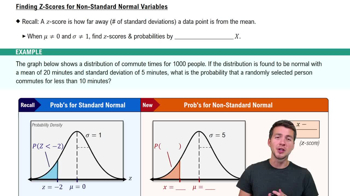
Finding Z-Scores for Non-Standard Normal Variables

Known Population Variances

The z-test requires that the population variances are known and used in the calculation of the standard error. If variances are unknown, a t-test is more appropriate. Knowing variances allows for precise estimation of variability in the test statistic.
Recommended video:
04:48
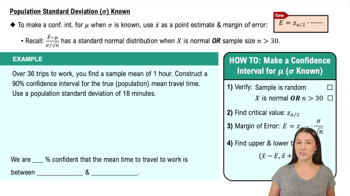
Population Standard Deviation Known

Independence of Samples

The two samples must be independent, meaning the selection or outcome of one sample does not influence the other. This ensures that the sampling distribution of the difference in means is valid and that the test results are reliable.
Recommended video:
Guided course
06:28
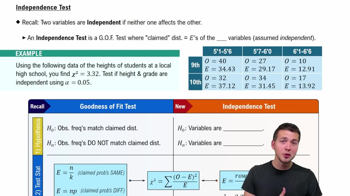
Independence Test
Related Practice
Textbook Question

Test the claim about the difference between two population means and at the level of significance α. Assume the samples are random and independent, and the populations are normally distributed.

Claim: μ1=μ2, α=0.01, Assume (σ1)^2=(σ2)^2

Textbook Question

Constructing Confidence Intervals for μ1-μ2. You can construct a confidence interval for the difference between two population means μ1-μ2 , as shown below, when both population standard deviations are known, and either both populations are normally distributed or both n1>= 30 and n2>=30 . Also, the samples must be randomly selected and independent.

[Image]

In Exercises 29 and 30, construct the indicated confidence interval for μ1-μ2 .


Software Engineer Salaries Construct a 95% confidence interval for the difference between the mean annual salaries of entry level software engineers in Santa Clara, California, and Greenwich, CT, using the data from Exercise 27.
Textbook Question

What conditions are necessary to use the t-test for testing the difference between two population means?

Textbook Question

[APPLET] Teaching Methods

A new method of teaching reading is being tested on third grade students. A group of third grade students is taught using the new curriculum. A control group of third grade students is taught using the old curriculum. The reading test scores for the two groups are shown in the back-to-back stem-and-leaf plot.

At , α=0.10 is there enough evidence to support the claim that the new method of teaching reading produces higher reading test scores than the old method does? Assume the population variances are equal.

Textbook Question

Blue Crabs A marine researcher claims that the stomachs of blue crabs from one location contain more fish than the stomachs of blue crabs from another location. The stomach contents of a sample of 25 blue crabs from Location A contain a mean of 320 milligrams of fish and a standard deviation of 60 milligrams. The stomach contents of a sample of 15 blue crabs from Location B contain a mean of 280 milligrams of fish and a standard deviation of 80 milligrams. At , α= 0.01can you support the marine researcher’s claim? Assume the population variances are equal.

Textbook Question

Testing the Difference Between Two Means In Exercises 15–24, (a) identify the claim and state Ho and Ha, (b) find the critical value(s) and identify the rejection region(s), (c) find the standardized test statistic z, (d) decide whether to reject or fail to reject the null hypothesis, and (e) interpret the decision in the context of the original claim. Assume the samples are random and independent, and the populations are normally distributed.

Braking Distances To compare the dry braking distances from 60 to 0 miles per hour for two makes of automobiles, a safety engineer conducts braking tests for 16 compact SUVs and 11 midsize SUVs. The mean braking distance for the compact SUVs is 131.8 feet. Assume the population standard deviation is 5.5 feet. The mean braking distance for the midsize SUVs is 132.8 feet. Assume the population standard deviation is 6.7 feet. At α=0.10 , can the engineer support the claim that the mean braking distances are different for the two categories of SUVs? (Adapted from Consumer Reports)