Ch. 8 - Hypothesis Testing with Two Samples
Larson - Elementary Statistics: Picturing the World 8th Edition
Larson8th EditionElementary Statistics: Picturing the WorldISBN: 9780137493470Not the one you use?Change textbook
Chapter 8, Problem 8.2.22

[APPLET] Teaching Methods
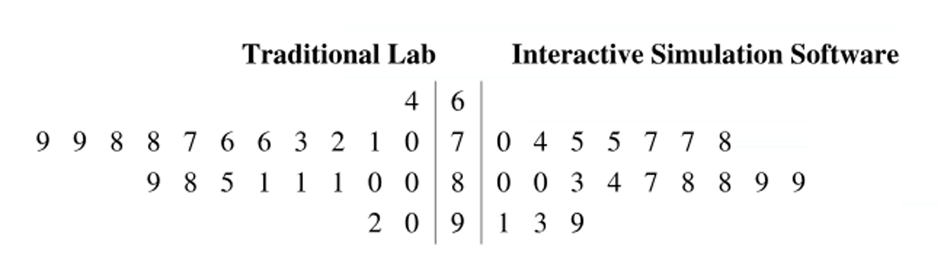
Two teaching methods and their effects on science test scores are being reviewed. A group of students is taught in traditional lab sessions. A second group of students is taught using interactive simulation software. The science test scores for the two groups are shown in the back-to-back stem-and-leaf plot.
At , α=0.01 can you support the claim that the mean science test score is lower for students taught using the traditional lab method than it is for students taught using the interactive simulation software? Assume the population variances are equal.
Back-to-back stem-and-leaf plot comparing science test scores of students in traditional lab and interactive simulation methods.

Verified step by step guidance
1
Step 1: Formulate the null and alternative hypotheses. The null hypothesis (H₀) states that the mean science test score for students taught using the traditional lab method is equal to or greater than the mean score for students taught using interactive simulation software. The alternative hypothesis (H₁) states that the mean score for students taught using the traditional lab method is lower than the mean score for students taught using interactive simulation software.
Step 2: Extract the data from the stem-and-leaf plot. For the traditional lab method, the scores are: 99, 98, 88, 87, 76, 66, 63, 21, 10, 9, 8, 5, 11, 11, 10, 0, 0, 20, 9. For the interactive simulation software, the scores are: 46, 45, 57, 77, 78, 80, 30, 34, 47, 78, 88, 89, 99, 13, 39.
Step 3: Calculate the sample means and standard deviations for both groups. Use the formula for the sample mean: x=xn, and the formula for the sample standard deviation: s=(x-x)2n-1. Perform these calculations for both groups.
Step 4: Conduct a two-sample t-test assuming equal variances. Use the formula for the t-statistic: t=(x-x)(s²/n)+(s²/n), where s² is the pooled variance. Calculate the degrees of freedom using the formula: df=n+n-2.
Step 5: Compare the calculated t-statistic to the critical t-value at α=0.01 for the given degrees of freedom. If the t-statistic is less than the critical t-value, reject the null hypothesis and conclude that the mean science test score is lower for students taught using the traditional lab method. Otherwise, fail to reject the null hypothesis.

Verified video answer for a similar problem:

This video solution was recommended by our tutors as helpful for the problem above.
Video duration:
7m
Was this helpful?

Key Concepts

Here are the essential concepts you must grasp in order to answer the question correctly.

Hypothesis Testing

Hypothesis testing is a statistical method used to make decisions about a population based on sample data. In this context, the null hypothesis (H0) posits that there is no difference in mean test scores between the two teaching methods, while the alternative hypothesis (H1) suggests that the mean score for the traditional lab method is lower. The significance level (α) indicates the threshold for rejecting the null hypothesis, with a common choice being 0.01 in this case.
Recommended video:
05:52
Performing Hypothesis Tests: Proportions

T-test for Independent Samples

A t-test for independent samples is used to compare the means of two groups when the population variances are assumed to be equal. This test calculates a t-statistic based on the difference between the sample means, the pooled standard deviation, and the sample sizes. The resulting t-value is then compared to a critical value from the t-distribution to determine if the difference is statistically significant at the chosen alpha level.
Recommended video:
Guided course
06:28
Independence Test

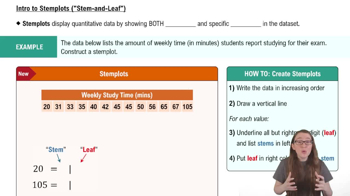
Stem-and-Leaf Plot

A stem-and-leaf plot is a graphical representation of quantitative data that helps visualize the distribution of scores. Each number is split into a 'stem' (the leading digit) and a 'leaf' (the trailing digit), allowing for easy identification of the shape and spread of the data. In this question, the stem-and-leaf plot compares the science test scores of students taught by traditional methods versus those using interactive simulations, providing a clear view of their performance.
Recommended video:
06:23
Creating Stemplots
Related Practice
Textbook Question

Test the claim about the difference between two population means and at the level of significance α. Assume the samples are random and independent, and the populations are normally distributed.

Claim: μ1<μ2, α=0.10, Assume (σ1)^2=(σ2)^2

Sample statistics:

x̅1=0.345, s1=0.305 , n1=11 and x̅2=0.515, s2=0.215, n2=9

1
views
Textbook Question

Testing the Difference Between Two Proportions In Exercises 7–12, (a) identify the claim and state Ho and Ha, (b) find the critical value(s) and identify the rejection region(s), (c) find the standardized test statistic z, (d) decide whether to reject or fail to reject the null hypothesis, and (e) interpret the decision in the context of the original claim. Assume the samples are random and independent.


Multiple Sclerosis Drug In a study to determine the effectiveness of using a drug to treat multiple sclerosis, 488 subjects were given the drug and 244 subjects were given a placebo. The numbers of subjects who had 12-week confirmed disability progression were tracked. The results are shown at the left. At α=0.01, can you support the claim that there is a difference in the proportion of subjects who had no 12-week confirmed disability progression? (Adapted from The New England Journal of Medicine)


Textbook Question

Young Adults In a survey of 3500 males ages 20 to 24 whose highest level of education is some college, but no bachelor’s degree, 80.2% were employed. In a survey of 2000 males ages 20 to 24 whose highest level of education is a bachelor’s degree or higher, 86.4% were employed. At α=0.01, can you support the claim that there is a difference in the proportion of those employed between the two groups? (Adapted from National Center for Education Statistics)

Textbook Question

Testing the Difference Between Two Means In Exercises 15–24, (a) identify the claim and state Ho and Ha, (b) find the critical value(s) and identify the rejection region(s), (c) find the standardized test statistic z, (d) decide whether to reject or fail to reject the null hypothesis, and (e) interpret the decision in the context of the original claim. Assume the samples are random and independent, and the populations are normally distributed.

Braking Distances To compare the dry braking distances from 60 to 0 miles per hour for two makes of automobiles, a safety engineer conducts braking tests for 16 compact SUVs and 11 midsize SUVs. The mean braking distance for the compact SUVs is 131.8 feet. Assume the population standard deviation is 5.5 feet. The mean braking distance for the midsize SUVs is 132.8 feet. Assume the population standard deviation is 6.7 feet. At α=0.10 , can the engineer support the claim that the mean braking distances are different for the two categories of SUVs? (Adapted from Consumer Reports)

Textbook Question

In Exercises 11–14, test the claim about the difference between two population means and at the level of significance . Assume the samples are random and independent, and the populations are normally distributed.

Claim: μ1<μ2; α=0.03

Population statistics:σ1=136 and σ2=215

Sample Statistics: x̅1=5004, n1=144, x̅2=4895, n2=156

Textbook Question

Independent and Dependent Samples In Exercises 5–8, classify the two samples as independent or dependent and justify your answer.

Sample 1: The IQ scores of 60 females

Sample 2: The IQ scores of 60 males