

Ch. 7 - Hypothesis Testing with One Sample
Larson - Elementary Statistics: Picturing the World 8th Edition
Larson8th EditionElementary Statistics: Picturing the WorldISBN: 9780137493470Not the one you use?Change textbook
Chapter 7, Problem 7.RS.3

You want your test to support a positive claim about your college, not just fail to reject one. Should you state your claim so that the null hypothesis contains the claim or the alternate hypothesis contains the claim? Explain.
Bar graph showing college costs, including tuition and financial aid amounts, with labeled categories and dollar values.

Verified step by step guidance
1
Step 1: Understand the purpose of hypothesis testing. Hypothesis testing is used to make inferences about a population based on sample data. The null hypothesis (H₀) represents the status quo or no effect, while the alternative hypothesis (H₁) represents the claim or effect you want to support.
Step 2: Recognize the goal of the test. Since you want to support a positive claim about your college, the claim should be placed in the alternative hypothesis (H₁). This is because rejecting the null hypothesis (H₀) provides evidence in favor of the alternative hypothesis (H₁).
Step 3: Formulate the hypotheses. For example, if the claim is that the average grant and scholarship aid is greater than \$13,690, the null hypothesis (H₀) would state that the average aid is less than or equal to \$13,690, while the alternative hypothesis (H₁) would state that the average aid is greater than \$13,690.
Step 4: Choose the appropriate test and significance level. Depending on the data available, you might use a t-test or z-test to compare the sample mean to the hypothesized mean. Select a significance level (e.g., α = 0.05) to determine the threshold for rejecting the null hypothesis.
Step 5: Interpret the results. If the test statistic falls in the rejection region (or the p-value is less than α), you reject the null hypothesis (H₀) and conclude that there is sufficient evidence to support the positive claim about your college.

Verified video answer for a similar problem:

This video solution was recommended by our tutors as helpful for the problem above.
Video duration:
2m
Was this helpful?

Key Concepts

Here are the essential concepts you must grasp in order to answer the question correctly.

Null Hypothesis (H0)

The null hypothesis is a statement that indicates no effect or no difference, serving as a default position in hypothesis testing. It is typically formulated to be tested against an alternative hypothesis. In this context, if you want to support a positive claim about your college, the null hypothesis would not contain this claim, as it represents the status quo or a lack of evidence for the claim.
Recommended video:
Guided course
06:21
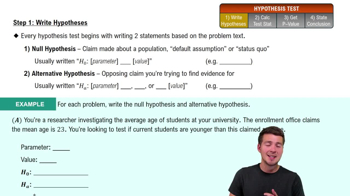
Step 1: Write Hypotheses

Alternative Hypothesis (H1)

The alternative hypothesis is a statement that reflects the claim or effect that the researcher aims to support. It is the hypothesis that is accepted if the null hypothesis is rejected. In this scenario, stating your claim in the alternative hypothesis allows you to test for evidence that supports your positive assertion about the college.
Recommended video:
Guided course
06:21
Step 1: Write Hypotheses

Hypothesis Testing

Hypothesis testing is a statistical method used to make decisions about the validity of a claim based on sample data. It involves comparing the null and alternative hypotheses using a significance level to determine whether to reject the null hypothesis. Understanding this process is crucial for effectively framing your claim and interpreting the results of your test.
Recommended video:
Guided course
06:21
Step 1: Write Hypotheses