Ch. 7 - Hypothesis Testing with One Sample
Larson - Elementary Statistics: Picturing the World 8th Edition
Larson8th EditionElementary Statistics: Picturing the WorldISBN: 9780137493470Not the one you use?Change textbook
Chapter 7, Problem 7.RE.29

In Exercises 29–34, find the critical value(s) and rejection region(s) for the type of t-test with level of significance α and sample size n.


Two-tailed test, α=0.05, n=20

Verified step by step guidance
1
Determine the degrees of freedom (df) for the t-test. The formula for degrees of freedom is df = n - 1, where n is the sample size. In this case, n = 20, so df = 20 - 1.
Identify the level of significance (α) for the test. For a two-tailed test, the significance level is split equally between the two tails of the t-distribution. Here, α = 0.05, so each tail will have α/2 = 0.025.
Use a t-distribution table or statistical software to find the critical t-value(s) corresponding to df = 19 and a cumulative probability of 1 - α/2 = 0.975 for the upper tail and α/2 = 0.025 for the lower tail.
The rejection region(s) for the two-tailed test are defined as the areas in the tails of the t-distribution where the test statistic falls beyond the critical t-values. Specifically, the rejection regions are t < -t_critical and t > t_critical.
Summarize the critical values and rejection regions. For example, if the critical t-values are ±t_critical, the rejection regions are t < -t_critical and t > t_critical. These regions indicate where the null hypothesis would be rejected.

Verified video answer for a similar problem:

This video solution was recommended by our tutors as helpful for the problem above.
Video duration:
2m
Was this helpful?

Key Concepts

Here are the essential concepts you must grasp in order to answer the question correctly.

Critical Value

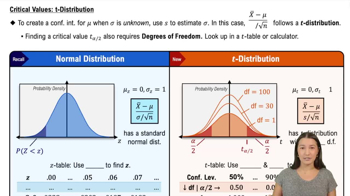
A critical value is a point on the scale of the test statistic beyond which we reject the null hypothesis. In a two-tailed test, there are two critical values that correspond to the significance level (α). For example, with α = 0.05, the critical values define the boundaries of the rejection regions in both tails of the distribution.
Recommended video:
05:50
Critical Values: t-Distribution

Rejection Region

The rejection region is the area in the tails of the probability distribution where we reject the null hypothesis. For a two-tailed test with α = 0.05, the rejection regions are located in both tails, each containing 2.5% of the total probability. If the test statistic falls within these regions, we conclude that the observed data is statistically significant.
Recommended video:
Guided course
09:56
Step 4: State Conclusion

t-Test

A t-test is a statistical test used to determine if there is a significant difference between the means of two groups, especially when the sample size is small (n < 30) and the population standard deviation is unknown. The t-test uses the t-distribution, which accounts for the additional uncertainty introduced by estimating the population standard deviation from the sample.
Recommended video:
05:50
Critical Values: t-Distribution