Ch. 7 - Hypothesis Testing with One Sample
Larson - Elementary Statistics: Picturing the World 8th Edition
Larson8th EditionElementary Statistics: Picturing the WorldISBN: 9780137493470Not the one you use?Change textbook
Chapter 7, Problem 7.RE.11

In Exercises 11 and 12, find the P-value for the hypothesis test with the standardized test statistic z. Decide whether to reject H0 for the level of significance α.


Left-tailed test, z = -0.94, α = 0.05

Verified step by step guidance
1
Step 1: Understand the problem. This is a left-tailed hypothesis test where the standardized test statistic z = -0.94, and the level of significance α = 0.05. The goal is to find the P-value and decide whether to reject the null hypothesis (H0).
Step 2: Recall that the P-value in a left-tailed test is the area under the standard normal curve to the left of the given z-value. Use the standard normal distribution table or a statistical software to find the cumulative probability corresponding to z = -0.94.
Step 3: Compare the P-value obtained in Step 2 with the level of significance α = 0.05. If the P-value is less than or equal to α, reject the null hypothesis (H0). Otherwise, fail to reject H0.
Step 4: Interpret the result. If you reject H0, it means there is sufficient evidence to support the alternative hypothesis. If you fail to reject H0, it means there is insufficient evidence to support the alternative hypothesis.
Step 5: Summarize the findings in the context of the problem, ensuring clarity on whether the null hypothesis was rejected or not based on the comparison of the P-value and α.

Verified video answer for a similar problem:

This video solution was recommended by our tutors as helpful for the problem above.
Video duration:
3m
Was this helpful?

Key Concepts

Here are the essential concepts you must grasp in order to answer the question correctly.

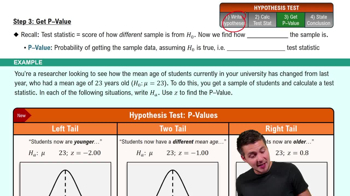
P-value

The P-value is a statistical measure that helps determine the significance of results in hypothesis testing. It represents the probability of obtaining a test statistic as extreme as, or more extreme than, the observed value under the null hypothesis. A smaller P-value indicates stronger evidence against the null hypothesis, leading to a decision to reject it if the P-value is less than the significance level (α).
Recommended video:
Guided course
06:50
Step 3: Get P-Value

Hypothesis Testing

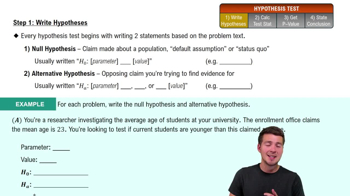
Hypothesis testing is a statistical method used to make inferences about population parameters based on sample data. It involves formulating two competing hypotheses: the null hypothesis (H0), which represents no effect or no difference, and the alternative hypothesis (H1), which represents the effect or difference. The goal is to determine whether there is enough evidence to reject H0 in favor of H1 based on the calculated test statistic and corresponding P-value.
Recommended video:
Guided course
06:21
Step 1: Write Hypotheses

Significance Level (α)

The significance level, denoted as α, is a threshold set by the researcher to determine when to reject the null hypothesis. Commonly set at 0.05, it represents a 5% risk of concluding that a difference exists when there is none (Type I error). If the P-value is less than or equal to α, the null hypothesis is rejected, indicating that the observed data is statistically significant at that level.
Recommended video:
03:33
Finding Binomial Probabilities Using TI-84 Example 1