Ch. 6 - Confidence Intervals
Larson - Elementary Statistics: Picturing the World 8th Edition
Larson8th EditionElementary Statistics: Picturing the WorldISBN: 9780137493470Not the one you use?Change textbook
Chapter 6, Problem 6.RSRD.4

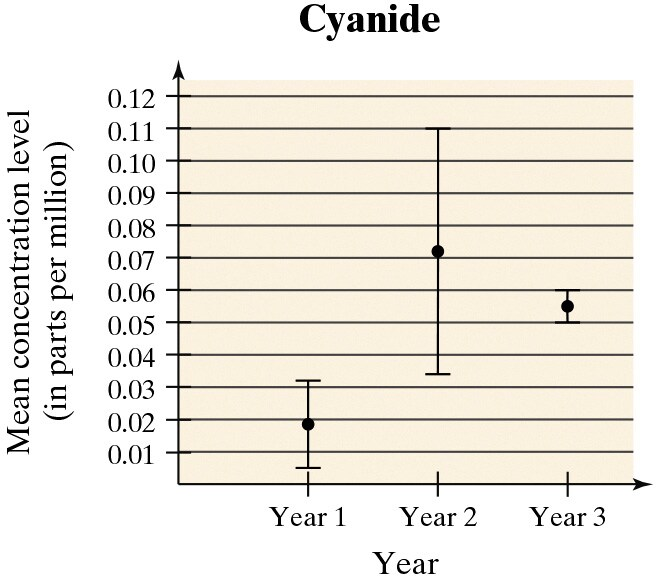
The Safe Drinking Water Act, which was passed in 1974, allows the Environmental Protection Agency (EPA) to regulate the levels of contaminants in drinking water. The EPA requires that water utilities give their customers water quality reports annually. These reports include the results of daily water quality monitoring, which is performed to determine whether drinking water is safe for consumption. A water department tests for contaminants at water treatment plants and at customers’ taps. These contaminants include microorganisms, organic chemicals, and inorganic chemicals, such as cyanide. Cyanide’s presence in drinking water is the result of discharges from steel, plastics, and fertilizer factories. For drinking water, the maximum contaminant level of cyanide is 0.2 parts per million. As part of your job for your city’s water department, you are preparing a report that includes an analysis of the results shown in the figure at the right. The figure shows the point estimates for the population mean concentration and the 95% confidence intervals for cyanide over a three-year period. The data are based on random water samples taken by the city’s three water treatment plants.
<IMAGE>
What can the water department do to decrease the size of the confidence intervals, regardless of the amount of variance in cyanide levels?

Verified step by step guidance
1
Step 1: Understand the concept of confidence intervals. A confidence interval provides a range of values within which the true population parameter (mean cyanide concentration in this case) is likely to fall, with a specified level of confidence (95% here). The width of the interval depends on the sample size, variability in the data, and the confidence level.
Step 2: Recognize that the size of the confidence interval is influenced by the standard error of the mean. The standard error is calculated as \( \text{SE} = \frac{\sigma}{\sqrt{n}} \), where \( \sigma \) is the standard deviation of the sample and \( n \) is the sample size. Increasing the sample size decreases the standard error, which in turn reduces the width of the confidence interval.
Step 3: To decrease the size of the confidence intervals, the water department can increase the sample size. This means collecting more water samples from the treatment plants and customers' taps. Larger sample sizes provide more precise estimates of the population mean.
Step 4: Another approach is to reduce variability in the data (\( \sigma \)). This can be achieved by improving the consistency of water treatment processes or by identifying and controlling sources of cyanide contamination more effectively.
Step 5: Ensure that the sampling method is random and representative of the population. This minimizes bias and ensures that the confidence intervals accurately reflect the true population mean. Combining these strategies will help decrease the size of the confidence intervals regardless of the variance in cyanide levels.

Verified video answer for a similar problem:

This video solution was recommended by our tutors as helpful for the problem above.
Video duration:
5m
Was this helpful?

Key Concepts

Here are the essential concepts you must grasp in order to answer the question correctly.

Confidence Interval

A confidence interval is a range of values, derived from sample statistics, that is likely to contain the true population parameter. It provides an estimate of uncertainty around a sample mean, typically expressed at a certain confidence level, such as 95%. The width of the interval reflects the variability in the data and the sample size; narrower intervals indicate more precise estimates.
Recommended video:
06:33
Introduction to Confidence Intervals

Sample Size

Sample size refers to the number of observations or data points collected in a study. Increasing the sample size generally leads to more reliable estimates of population parameters and can reduce the width of confidence intervals. This is because larger samples tend to provide a better representation of the population, thus decreasing variability and uncertainty in the estimates.
Recommended video:
05:11
Sampling Distribution of Sample Proportion

Variance

Variance is a statistical measure that represents the degree of spread in a set of data points. It quantifies how much the values in a dataset differ from the mean. High variance indicates that the data points are widely spread out, while low variance suggests they are closer to the mean. Reducing variance can help narrow confidence intervals, but it is also influenced by the sample size and the inherent variability of the data.
Recommended video:
Guided course
04:48
Variance & Standard Deviation of Discrete Random Variables
Related Practice
Textbook Question

(a) Construct a 90% confidence interval for the population mean in Exercise 1. Interpret the results. (b) Does it seem likely that the population mean could be within 10% of the sample mean? Explain.

Textbook Question

In Exercises 27–30, find the critical values and for the level of confidence c and sample size n.

c = 0.95, n = 13

Textbook Question

In Exercises 27–30, find the critical values and for the level of confidence c and sample size n.

c = 0.98, n = 25

Textbook Question

The data set represents the scores of 12 randomly selected students on the SAT Physics Subject Test. Assume the population test scores are normally distributed and the population standard deviation is 108. (Adapted from The College Board)

d. Determine the minimum sample size required to be 95% confident that the sample mean test score is within 10 points of the population mean test score.

Textbook Question

Use the standard normal distribution or the t-distribution to construct the indicated confidence interval for the population mean of each data set. Justify your decision. If neither distribution can be used, explain why. Interpret the results.

b. In a random sample of 15 cereal boxes, the mean weight was 11.89 ounces. Assume the weights of the cereal boxes are normally distributed and the population standard deviation is 0.05 ounce. Construct a 90% confidence interval for the population mean.

Textbook Question

The Safe Drinking Water Act, which was passed in 1974, allows the Environmental Protection Agency (EPA) to regulate the levels of contaminants in drinking water. The EPA requires that water utilities give their customers water quality reports annually. These reports include the results of daily water quality monitoring, which is performed to determine whether drinking water is safe for consumption. A water department tests for contaminants at water treatment plants and at customers’ taps. These contaminants include microorganisms, organic chemicals, and inorganic chemicals, such as cyanide. Cyanide’s presence in drinking water is the result of discharges from steel, plastics, and fertilizer factories. For drinking water, the maximum contaminant level of cyanide is 0.2 parts per million. As part of your job for your city’s water department, you are preparing a report that includes an analysis of the results shown in the figure at the right. The figure shows the point estimates for the population mean concentration and the 95% confidence intervals for cyanide over a three-year period. The data are based on random water samples taken by the city’s three water treatment plants.

The confidence interval for Year 2 is much larger than that for the other years. What do you think may have caused this larger confidence level?