
Ch. 6 - Confidence Intervals
Larson - Elementary Statistics: Picturing the World 8th Edition
Larson8th EditionElementary Statistics: Picturing the WorldISBN: 9780137493470Not the one you use?Change textbook
Chapter 6, Problem 6.R.3

(a) Construct a 90% confidence interval for the population mean in Exercise 1. Interpret the results. (b) Does it seem likely that the population mean could be within 10% of the sample mean? Explain.

Verified step by step guidance
1
Step 1: Identify the necessary components for constructing a confidence interval. You will need the sample mean (\( \bar{x} \)), the sample standard deviation (\( s \)), the sample size (\( n \)), and the critical value (\( t^* \)) for a 90% confidence level. The critical value can be found using a t-distribution table or statistical software, based on the degrees of freedom \( df = n - 1 \).
Step 2: Use the formula for the confidence interval for the population mean: \( \bar{x} \pm t^* \cdot \frac{s}{\sqrt{n}} \). Substitute the values for \( \bar{x} \), \( t^* \), \( s \), and \( n \) into the formula to calculate the lower and upper bounds of the confidence interval.
Step 3: Interpret the confidence interval. A 90% confidence interval means that if we were to take many random samples and construct confidence intervals for each, approximately 90% of those intervals would contain the true population mean. State the interval in the context of the problem.
Step 4: To determine if the population mean could be within 10% of the sample mean, calculate 10% of the sample mean (\( 0.1 \cdot \bar{x} \)) and check if this range falls entirely within the confidence interval. If it does, it is likely; if not, it is unlikely.
Step 5: Provide an explanation based on the results. If the range of 10% around the sample mean is within the confidence interval, explain why this suggests the population mean could plausibly be within that range. If not, explain why the confidence interval suggests otherwise.

Verified video answer for a similar problem:

This video solution was recommended by our tutors as helpful for the problem above.
Video duration:
7m
Was this helpful?

Key Concepts

Here are the essential concepts you must grasp in order to answer the question correctly.

Confidence Interval

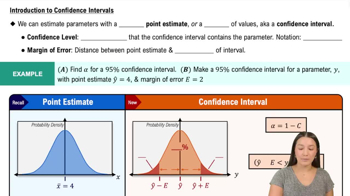
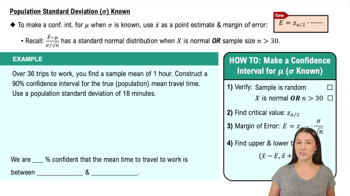
A confidence interval is a range of values, derived from sample statistics, that is likely to contain the population parameter with a specified level of confidence, such as 90%. It is calculated using the sample mean, the standard error, and a critical value from the t-distribution or z-distribution, depending on the sample size and whether the population standard deviation is known.
Recommended video:
06:33
Introduction to Confidence Intervals

Population Mean

The population mean is the average of all possible values in a population. It is a parameter that represents the central tendency of the entire group, as opposed to the sample mean, which is calculated from a subset of the population. Understanding the difference between these two means is crucial for making inferences about the population based on sample data.
Recommended video:
04:48
Population Standard Deviation Known

Margin of Error

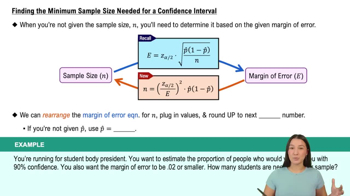
The margin of error quantifies the uncertainty associated with a sample estimate. It indicates how much the sample mean is expected to differ from the true population mean. In the context of confidence intervals, a smaller margin of error suggests a more precise estimate, while a larger margin of error indicates greater uncertainty about the population mean's location relative to the sample mean.
Recommended video:
04:08
Finding the Minimum Sample Size Needed for a Confidence Interval
Related Practice
Textbook Question

The Safe Drinking Water Act, which was passed in 1974, allows the Environmental Protection Agency (EPA) to regulate the levels of contaminants in drinking water. The EPA requires that water utilities give their customers water quality reports annually. These reports include the results of daily water quality monitoring, which is performed to determine whether drinking water is safe for consumption. A water department tests for contaminants at water treatment plants and at customers’ taps. These contaminants include microorganisms, organic chemicals, and inorganic chemicals, such as cyanide. Cyanide’s presence in drinking water is the result of discharges from steel, plastics, and fertilizer factories. For drinking water, the maximum contaminant level of cyanide is 0.2 parts per million. As part of your job for your city’s water department, you are preparing a report that includes an analysis of the results shown in the figure at the right. The figure shows the point estimates for the population mean concentration and the 95% confidence intervals for cyanide over a three-year period. The data are based on random water samples taken by the city’s three water treatment plants.

What can the water department do to decrease the size of the confidence intervals, regardless of the amount of variance in cyanide levels?

Textbook Question

In Exercises 27–30, find the critical values and for the level of confidence c and sample size n.

c = 0.95, n = 13

Textbook Question

In Exercises 27–30, find the critical values and for the level of confidence c and sample size n.

c = 0.98, n = 25

Textbook Question

In a random sample of 36 top-rated roller coasters, the average height is 165 feet and the standard deviation is 67 feet. Construct a 90% confidence interval for μ. Interpret the results. (Source: POP World Media, LLC)

Textbook Question

In Exercises 5 and 6, use the confidence interval to find the margin of error and the sample mean.

(7.428, 7.562)

1
views
Textbook Question

Determine the minimum sample size required to be 99% confident that the sample mean driving distance to work is within 2 miles of the population mean driving distance to work. Use the population standard deviation from Exercise 2.