
Ch. 6 - Confidence Intervals
Larson - Elementary Statistics: Picturing the World 8th Edition
Larson8th EditionElementary Statistics: Picturing the WorldISBN: 9780137493470Not the one you use?Change textbook
Chapter 6, Problem 6.Q.3c

The data set represents the amounts of time (in minutes) spent checking email for a random sample of employees at a company.
c. Repeat part (b), assuming σ = 3.5 minutes. Compare the results.

Verified step by step guidance
1
Identify the statistical test to be used. Since the population standard deviation (σ = 3.5 minutes) is provided, you will use a z-test for the mean.
Write down the null hypothesis (H₀) and the alternative hypothesis (Hₐ). Typically, H₀ states that the population mean is equal to a specific value (e.g., μ = μ₀), and Hₐ states that the population mean is different (two-tailed) or greater/less than μ₀ (one-tailed).
Calculate the z-test statistic using the formula: z = (x̄ - μ₀) / (σ / √n), where x̄ is the sample mean, μ₀ is the hypothesized population mean, σ is the population standard deviation, and n is the sample size.
Determine the critical z-value(s) based on the significance level (α) and the type of test (one-tailed or two-tailed). Use a z-table or standard normal distribution to find these values.
Compare the calculated z-test statistic to the critical z-value(s). If the test statistic falls in the rejection region, reject the null hypothesis (H₀). Otherwise, fail to reject H₀. Summarize the conclusion in the context of the problem.

Verified video answer for a similar problem:

This video solution was recommended by our tutors as helpful for the problem above.
Video duration:
7m
Was this helpful?

Key Concepts

Here are the essential concepts you must grasp in order to answer the question correctly.

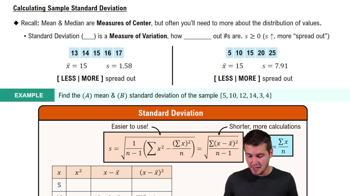
Standard Deviation (σ)

Standard deviation is a measure of the amount of variation or dispersion in a set of values. A low standard deviation indicates that the values tend to be close to the mean, while a high standard deviation indicates that the values are spread out over a wider range. In this context, assuming σ = 3.5 minutes means that this is the expected variability in the time spent checking email.
Recommended video:
Guided course
08:45
Calculating Standard Deviation

Sampling Distribution

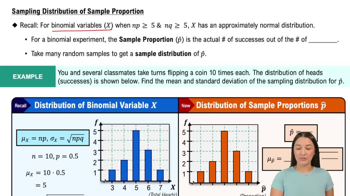
The sampling distribution is the probability distribution of a statistic (like the sample mean) obtained from a large number of samples drawn from a specific population. Understanding this concept is crucial for making inferences about the population based on sample data, especially when comparing results under different assumptions, such as varying standard deviations.
Recommended video:
05:11
Sampling Distribution of Sample Proportion

Confidence Intervals

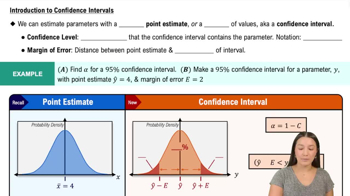
A confidence interval is a range of values, derived from a data set, that is likely to contain the value of an unknown population parameter. It provides an estimate of uncertainty around a sample statistic. In this question, comparing confidence intervals under different assumptions of standard deviation will help assess how the variability affects the precision of the estimates.
Recommended video:
06:33
Introduction to Confidence Intervals
Related Practice
Textbook Question

[APPLET] The winning times (in hours) for a sample of 20 randomly selected Boston Marathon Women’s Open Division champions from 1980 to 2019 are shown in the table at the left. Assume the population standard deviation is 0.068 hour. (Source: Boston Athletic Association)

a. Find the point estimate of the population mean.

Textbook Question

[APPLET] The winning times (in hours) for a sample of 20 randomly selected Boston Marathon Women’s Open Division champions from 1980 to 2019 are shown in the table at the left. Assume the population standard deviation is 0.068 hour. (Source: Boston Athletic Association)

b. Find the margin of error for a 95% confidence level.

Textbook Question

You wish to estimate the mean winning time for Boston Marathon Women’s Open Division champions. The estimate must be within 2 minutes of the population mean. Determine the minimum sample size required to construct a 99% confidence interval for the population mean. Use the population standard deviation from Exercise 1.

Textbook Question

In a random sample of 12 senior-level civil engineers, the mean annual earnings were \$133,326 and the standard deviation was \$36,729. Assume the annual earnings are normally distributed and construct a 95% confidence interval for the population mean annual earnings for senior-level civil engineers. Interpret the results. (Adapted from Salary.com)

Textbook Question

[APPLET] The winning times (in hours) for a sample of 20 randomly selected Boston Marathon Women’s Open Division champions from 1980 to 2019 are shown in the table at the left. Assume the population standard deviation is 0.068 hour. (Source: Boston Athletic Association)

d. Does it seem likely that the population mean could be greater than 2.52 hours? Explain.

Textbook Question

You research the salaries of senior-level civil engineers and find that the population mean is \$131,935. In Exercise 4, does the t-value fall between -t0.95 and t0.95?