Ch. 6 - Confidence Intervals
Larson - Elementary Statistics: Picturing the World 8th Edition
Larson8th EditionElementary Statistics: Picturing the WorldISBN: 9780137493470Not the one you use?Change textbook
Chapter 6, Problem 6.2.15

In Exercises 15 and 16, find the t-value for the given values of xbar, μ, s and n.
xbar = 70.3, μ = 64.8, s = 7.1, n = 16

Verified step by step guidance
1
Step 1: Recall the formula for the t-value in a one-sample t-test: t = \(\frac{x̄ - μ}{s / \sqrt{n}\)}, where x̄ is the sample mean, μ is the population mean, s is the sample standard deviation, and n is the sample size.
Step 2: Substitute the given values into the formula: x̄ = 70.3, μ = 64.8, s = 7.1, and n = 16. The formula becomes: t = \(\frac{70.3 - 64.8}{7.1 / \sqrt{16}\)}.
Step 3: Simplify the denominator by calculating the standard error of the mean: \(\text{Standard Error}\) = \(\frac{s}{\sqrt{n}\)} = \(\frac{7.1}{\sqrt{16}\)}. Compute the square root of 16 and divide 7.1 by the result.
Step 4: Subtract the population mean (μ) from the sample mean (x̄): 70.3 - 64.8. This gives the numerator of the t-value formula.
Step 5: Divide the result from Step 4 (numerator) by the result from Step 3 (denominator) to calculate the t-value: t = \(\frac{\text{Numerator}\)}{\(\text{Denominator}\)}.

Verified video answer for a similar problem:

This video solution was recommended by our tutors as helpful for the problem above.
Video duration:
1m
Was this helpful?

Key Concepts

Here are the essential concepts you must grasp in order to answer the question correctly.

t-value

The t-value is a statistic used in hypothesis testing to determine if there is a significant difference between the sample mean and the population mean. It is calculated by taking the difference between the sample mean (x̄) and the population mean (μ), and dividing it by the standard error of the mean. The t-value helps assess how far the sample mean is from the population mean in terms of standard deviations.
Recommended video:
05:50
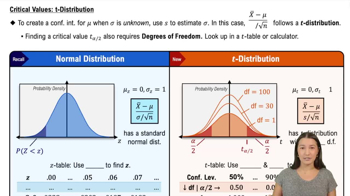
Critical Values: t-Distribution

Standard Error of the Mean (SEM)

The Standard Error of the Mean (SEM) quantifies how much the sample mean (x̄) is expected to vary from the true population mean (μ). It is calculated by dividing the sample standard deviation (s) by the square root of the sample size (n). A smaller SEM indicates that the sample mean is a more accurate estimate of the population mean, which is crucial for calculating the t-value.
Recommended video:
Guided course
04:52
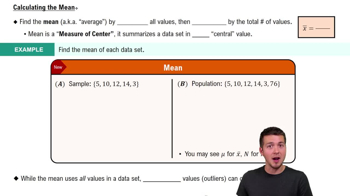
Calculating the Mean

Degrees of Freedom

Degrees of freedom (df) refer to the number of independent values that can vary in a statistical calculation. In the context of a t-test, the degrees of freedom are typically calculated as n - 1, where n is the sample size. This concept is important because it affects the shape of the t-distribution used to determine critical values and p-values in hypothesis testing.
Recommended video:
05:50
Critical Values: t-Distribution