
Ch. 6 - Confidence Intervals
Larson - Elementary Statistics: Picturing the World 8th Edition
Larson8th EditionElementary Statistics: Picturing the WorldISBN: 9780137493470Not the one you use?Change textbook
Chapter 6, Problem 6.2.30

In Exercise 28, the population mean weekly time spent on homework by students is 7.8 hours. Does the t-value fall between -t0.99 and t0.99?

Verified step by step guidance
1
Step 1: Identify the null hypothesis (H0) and the alternative hypothesis (H1). The null hypothesis typically states that the sample mean is equal to the population mean (H0: μ = 7.8), while the alternative hypothesis suggests a difference (H1: μ ≠ 7.8).
Step 2: Calculate the t-value using the formula: t = - μsn, where is the sample mean, μ is the population mean, s is the sample standard deviation, and n is the sample size.
Step 3: Determine the critical t-values for a 99% confidence level (two-tailed test). These values are denoted as -t0.99 and t0.99. Use a t-distribution table or statistical software to find these values based on the degrees of freedom (df = n - 1).
Step 4: Compare the calculated t-value from Step 2 to the critical t-values from Step 3. If the t-value falls between -t0.99 and t0.99, the null hypothesis is not rejected. Otherwise, the null hypothesis is rejected.
Step 5: Conclude whether the t-value falls within the range of -t0.99 and t0.99, and interpret the result in the context of the problem. This will help determine if the sample mean significantly differs from the population mean.

Verified video answer for a similar problem:

This video solution was recommended by our tutors as helpful for the problem above.
Video duration:
3m
Was this helpful?

Key Concepts

Here are the essential concepts you must grasp in order to answer the question correctly.

Population Mean

The population mean is the average of a set of values in a complete population. In this context, it represents the average weekly time spent on homework by all students, which is given as 7.8 hours. Understanding the population mean is crucial for making inferences about the data and comparing sample statistics.
Recommended video:
04:48
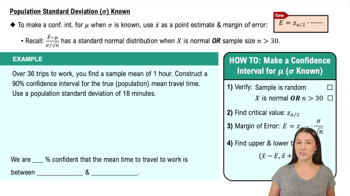
Population Standard Deviation Known

T-Value

The t-value is a statistic that measures the size of the difference relative to the variation in your sample data. It is used in hypothesis testing to determine if the means of two groups are statistically different from each other. In this case, the t-value will help assess whether the observed data significantly deviates from the population mean.
Recommended video:
05:50
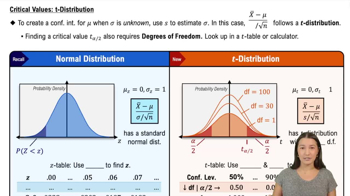
Critical Values: t-Distribution

T-Distribution

The t-distribution is a type of probability distribution that is symmetric and bell-shaped, similar to the normal distribution but with heavier tails. It is used in statistics when the sample size is small and the population standard deviation is unknown. The critical values, such as -t0.99 and t0.99, define the cutoff points for determining statistical significance in hypothesis testing.
Recommended video:
05:50
Critical Values: t-Distribution