
Ch. 6 - Confidence Intervals
Larson - Elementary Statistics: Picturing the World 8th Edition
Larson8th EditionElementary Statistics: Picturing the WorldISBN: 9780137493470Not the one you use?Change textbook
Chapter 6, Problem 6.3.25

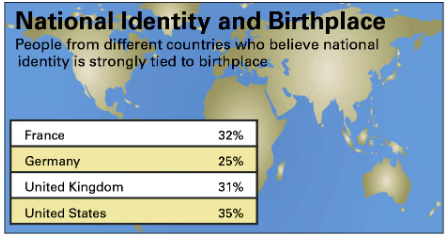
Constructing Confidence Intervals In Exercises 25 and 26, use the figure, which shows the results of a survey in which 1051 adults from France, 1042 adults from Germany, 1003 adults from the United Kingdom, and 1000 adults from the United States were asked whether national identity is strongly tied to birthplace. (Source: Pew Research Center)
Map showing survey results on national identity tied to birthplace: France 32%, Germany 25%, UK 31%, US 35%.
National Identity Construct a 99% confidence interval for the population proportion of adults who say national identity is strongly tied to birthplace for each country listed.

Verified step by step guidance
1
Step 1: Identify the sample size (n) and sample proportion (p̂) for each country. From the image, the sample sizes are: France (n=1051, p̂=0.32), Germany (n=1042, p̂=0.25), United Kingdom (n=1003, p̂=0.31), and United States (n=1000, p̂=0.35).
Step 2: Determine the critical value (z*) for a 99% confidence interval. For a 99% confidence level, the z* value is approximately 2.576 (based on the standard normal distribution).
Step 3: Calculate the standard error (SE) for each country using the formula: SE = sqrt((p̂ * (1 - p̂)) / n). Substitute the values of p̂ and n for each country into this formula.
Step 4: Compute the margin of error (ME) for each country using the formula: ME = z* * SE. Use the z* value from Step 2 and the SE calculated in Step 3.
Step 5: Construct the confidence interval for each country using the formula: Confidence Interval = p̂ ± ME. Substitute the values of p̂ and ME for each country to find the range of the confidence interval.

Verified video answer for a similar problem:

This video solution was recommended by our tutors as helpful for the problem above.
Video duration:
5m
Was this helpful?

Key Concepts

Here are the essential concepts you must grasp in order to answer the question correctly.

Confidence Interval

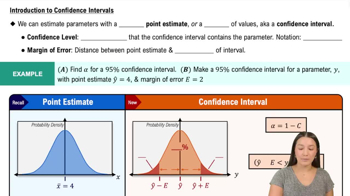
A confidence interval is a range of values, derived from sample statistics, that is likely to contain the true population parameter. It is expressed with a certain level of confidence, such as 99%, indicating the degree of certainty that the interval includes the parameter. For example, if a survey reports a 99% confidence interval for a population proportion, it means that if the survey were repeated multiple times, 99% of the calculated intervals would contain the true proportion.
Recommended video:
06:33
Introduction to Confidence Intervals

Population Proportion

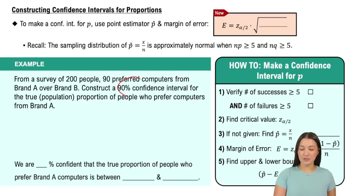
The population proportion is the fraction of a population that possesses a certain characteristic, often denoted as 'p'. In the context of the question, it refers to the proportion of adults in each country who believe that national identity is strongly tied to birthplace. Understanding this concept is crucial for constructing confidence intervals, as it helps to estimate the true sentiment of the entire population based on sample data.
Recommended video:
05:45
Constructing Confidence Intervals for Proportions

Sample Size

Sample size refers to the number of observations or data points collected in a survey or study. In this case, the sample sizes for each country are 1051 for France, 1042 for Germany, 1003 for the United Kingdom, and 1000 for the United States. A larger sample size generally leads to more reliable estimates and narrower confidence intervals, as it reduces the margin of error and increases the precision of the population proportion estimate.
Recommended video:
05:11
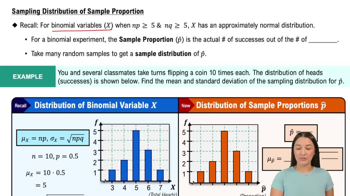
Sampling Distribution of Sample Proportion
Related Practice
Textbook Question

Translating Statements In Exercises 29–34, translate the statement into a confidence interval. Approximate the level of confidence.

In a survey of 880 unmarried U.S. adults who are living with a partner, 73% say love was a major reason why they decided to move in together. The survey’s margin of error is ±4.8%. (Source: Pew Research Center)

Textbook Question

Does a population have to be normally distributed to use the chi-square distribution?

Textbook Question

Constructing a Confidence Interval In Exercises 17–20, you are given the sample mean and the sample standard deviation. Assume the population is normally distributed and use the t-distribution to find the margin of error and construct a 95% confidence interval for the population mean. Interpret the results.

Commute Time In a random sample of eight people, the mean commute time to work was 35.5 minutes and the standard deviation was 7.2 minute

Textbook Question

In Exercises 7–10, use the confidence interval to find the margin of error and the sample proportion.

(0.087, 0.263)

Textbook Question

Choosing a Distribution In Exercises 35–40, use the standard normal distribution or the t-distribution to construct a 95% confidence interval for the population mean. Justify your decision. If neither distribution can be used, explain why. Interpret the results.

Body Mass Index In a random sample of 50 people, the mean body mass index (BMI) was 27.7 and the standard deviation was 6.12.

Textbook Question

A researcher claims that 5% of people who wear eyeglasses purchase their eyeglasses online. Describe type I and type II errors for a hypothesis test of the claim. (Source: Consumer Reports)