
Ch. 6 - Confidence Intervals
Larson - Elementary Statistics: Picturing the World 8th Edition
Larson8th EditionElementary Statistics: Picturing the WorldISBN: 9780137493470Not the one you use?Change textbook
Chapter 6, Problem 6.2.17

Constructing a Confidence Interval In Exercises 17–20, you are given the sample mean and the sample standard deviation. Assume the population is normally distributed and use the t-distribution to find the margin of error and construct a 95% confidence interval for the population mean. Interpret the results.
Commute Time In a random sample of eight people, the mean commute time to work was 35.5 minutes and the standard deviation was 7.2 minute

Verified step by step guidance
1
Step 1: Identify the given values from the problem. The sample mean (\( \bar{x} \)) is 35.5 minutes, the sample standard deviation (\( s \)) is 7.2 minutes, the sample size (\( n \)) is 8, and the confidence level is 95%.
Step 2: Determine the critical value (\( t^* \)) for a 95% confidence level using the t-distribution. The degrees of freedom (\( df \)) are calculated as \( n - 1 \), which is \( 8 - 1 = 7 \). Use a t-table or statistical software to find \( t^* \) for \( df = 7 \) and a two-tailed test with \( \alpha = 0.05 \).
Step 3: Calculate the standard error of the mean (\( SE \)) using the formula \( SE = \frac{s}{\sqrt{n}} \). Substitute \( s = 7.2 \) and \( n = 8 \) into the formula.
Step 4: Compute the margin of error (\( ME \)) using the formula \( ME = t^* \cdot SE \). Multiply the critical value (\( t^* \)) by the standard error (\( SE \)) calculated in the previous step.
Step 5: Construct the confidence interval for the population mean using the formula \( \bar{x} \pm ME \). Add and subtract the margin of error (\( ME \)) from the sample mean (\( \bar{x} \)) to find the lower and upper bounds of the confidence interval. Interpret the results by stating that you are 95% confident the true population mean commute time lies within this interval.

Verified video answer for a similar problem:

This video solution was recommended by our tutors as helpful for the problem above.
Video duration:
3m
Was this helpful?

Key Concepts

Here are the essential concepts you must grasp in order to answer the question correctly.

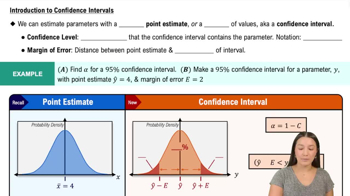
Confidence Interval

A confidence interval is a range of values, derived from sample statistics, that is likely to contain the population parameter with a specified level of confidence, typically expressed as a percentage. For example, a 95% confidence interval suggests that if we were to take many samples and construct intervals in the same way, approximately 95% of those intervals would contain the true population mean.
Recommended video:
06:33
Introduction to Confidence Intervals

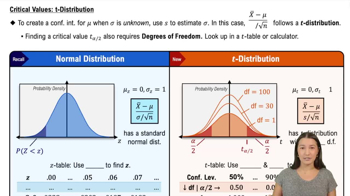
t-Distribution

The t-distribution is a type of probability distribution that is symmetric and bell-shaped, similar to the normal distribution, but has heavier tails. It is used instead of the normal distribution when the sample size is small (typically less than 30) and the population standard deviation is unknown. The t-distribution accounts for the additional uncertainty introduced by estimating the population standard deviation from the sample.
Recommended video:
05:50
Critical Values: t-Distribution

Margin of Error

The margin of error is a statistic that expresses the amount of random sampling error in a survey's results. It quantifies the uncertainty associated with the sample estimate and is calculated as the product of the critical value from the t-distribution and the standard error of the sample mean. A smaller margin of error indicates a more precise estimate of the population parameter.
Recommended video:
04:08
Finding the Minimum Sample Size Needed for a Confidence Interval
Related Practice
Textbook Question

"Finding p^ and q^ In Exercises 3–6, let p be the population proportion for the situation. Find point estimates of p and q.

Tax Fraud In a survey of 1040 U.S. adults, 62 have had someone impersonate them to try to claim tax refunds. (Adapted from Pew Research Center)"

Textbook Question

Translating Statements In Exercises 29–34, translate the statement into a confidence interval. Approximate the level of confidence.

In a survey of 880 unmarried U.S. adults who are living with a partner, 73% say love was a major reason why they decided to move in together. The survey’s margin of error is ±4.8%. (Source: Pew Research Center)

Textbook Question

Does a population have to be normally distributed to use the chi-square distribution?

Textbook Question

Constructing Confidence Intervals In Exercises 25 and 26, use the figure, which shows the results of a survey in which 1051 adults from France, 1042 adults from Germany, 1003 adults from the United Kingdom, and 1000 adults from the United States were asked whether national identity is strongly tied to birthplace. (Source: Pew Research Center)

National Identity Construct a 99% confidence interval for the population proportion of adults who say national identity is strongly tied to birthplace for each country listed.

Textbook Question

In Exercises 7–10, use the confidence interval to find the margin of error and the sample proportion.

(0.087, 0.263)

Textbook Question

Choosing a Distribution In Exercises 35–40, use the standard normal distribution or the t-distribution to construct a 95% confidence interval for the population mean. Justify your decision. If neither distribution can be used, explain why. Interpret the results.

Body Mass Index In a random sample of 50 people, the mean body mass index (BMI) was 27.7 and the standard deviation was 6.12.