
Ch. 6 - Confidence Intervals
Larson - Elementary Statistics: Picturing the World 8th Edition
Larson8th EditionElementary Statistics: Picturing the WorldISBN: 9780137493470Not the one you use?Change textbook
Chapter 6, Problem 6.4.21b

Constructing Confidence Intervals In Exercises 13–24, assume the sample is from a normally distributed population and construct the indicated confidence intervals for (b) the population standard deviation σ. Interpret the results.
Car Batteries The reserve capacities (in hours) of 18 randomly selected automotive batteries have a sample standard deviation of 0.25 hour. Use an 80% level of confidence.

Verified step by step guidance
1
Step 1: Identify the given information. The sample size (n) is 18, the sample standard deviation (s) is 0.25 hours, and the confidence level is 80%. The population is assumed to be normally distributed.
Step 2: Recall the formula for constructing a confidence interval for the population standard deviation (σ). The formula involves the chi-square distribution: \( \sqrt{\frac{(n-1)s^2}{\chi^2_{\text{upper}}}} \leq \sigma \leq \sqrt{\frac{(n-1)s^2}{\chi^2_{\text{lower}}}} \), where \( \chi^2_{\text{upper}} \) and \( \chi^2_{\text{lower}} \) are the critical values of the chi-square distribution.
Step 3: Determine the degrees of freedom (df). The degrees of freedom for the chi-square distribution is \( df = n - 1 \). In this case, \( df = 18 - 1 = 17 \).
Step 4: Find the critical values \( \chi^2_{\text{upper}} \) and \( \chi^2_{\text{lower}} \) for an 80% confidence level. Since the confidence level is 80%, the remaining 20% is split equally into the two tails of the chi-square distribution. Use a chi-square table or calculator to find these critical values for \( df = 17 \).
Step 5: Substitute the values into the confidence interval formula. Use \( n = 18 \), \( s = 0.25 \), and the critical values \( \chi^2_{\text{upper}} \) and \( \chi^2_{\text{lower}} \) to calculate the lower and upper bounds of the confidence interval for \( \sigma \). Finally, interpret the interval in the context of the problem, explaining that it provides a range of plausible values for the population standard deviation of the reserve capacities of automotive batteries.

Verified video answer for a similar problem:

This video solution was recommended by our tutors as helpful for the problem above.
Video duration:
4m
Was this helpful?

Key Concepts

Here are the essential concepts you must grasp in order to answer the question correctly.

Confidence Interval

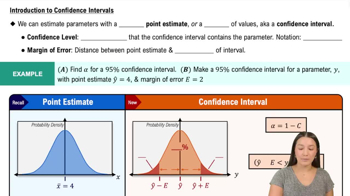
A confidence interval is a range of values, derived from a sample, that is likely to contain the population parameter with a specified level of confidence. For example, an 80% confidence interval suggests that if we were to take many samples and construct intervals in the same way, approximately 80% of those intervals would contain the true population parameter.
Recommended video:
06:33
Introduction to Confidence Intervals

Population Standard Deviation (σ)

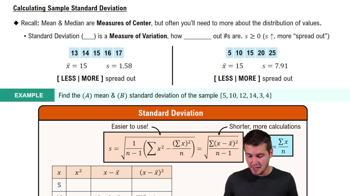
The population standard deviation (σ) is a measure of the amount of variation or dispersion in a set of values in the entire population. It quantifies how much individual data points differ from the population mean. In the context of confidence intervals, estimating σ helps in determining the width of the interval.
Recommended video:
Guided course
08:45
Calculating Standard Deviation

Sample Standard Deviation

The sample standard deviation is a statistic that estimates the population standard deviation based on a sample. It reflects the variability of the sample data and is calculated using the formula that accounts for the degrees of freedom. In this exercise, the sample standard deviation of 0.25 hours is crucial for constructing the confidence interval for the population standard deviation.
Recommended video:
Guided course
08:45
Calculating Standard Deviation
Related Practice
Textbook Question

Constructing Confidence Intervals In Exercises 13–24, assume the sample is from a normally distributed population and construct the indicated confidence intervals for (b) the population standard deviation σ. Interpret the results.

Drug Concentration The times (in minutes) for the drug concentration to peak when the drug epinephrine is injected into 15 randomly selected patients are listed. Use a 90% level of confidence.

Textbook Question

Constructing Confidence Intervals In Exercises 13–24, assume the sample is from a normally distributed population and construct the indicated confidence intervals for (b) the population standard deviation σ. Interpret the results.

[APPLET] Earnings The annual earnings (in thousands of dollars) of 21 randomly selected level 1 computer hardware engineers are listed. Use a 99% level of confidence. (Adapted from Salary.com)

Textbook Question

Constructing Confidence Intervals In Exercises 13–24, assume the sample is from a normally distributed population and construct the indicated confidence intervals for (b) the population standard deviation σ. Interpret the results.

Drive-Thru Times The times (in seconds) spent by a random sample of 28 customers in the drive-thru of a fast-food restaurant have a sample standard deviation of 56.1. Use a 98% level of confidence.

Textbook Question

When all other quantities remain the same, how does the indicated change affect the width of a confidence interval? Explain.

b. Increase in the sample size

Textbook Question

Constructing a Confidence Interval In Exercises 31 and 32, use the data set to (b) find the sample standard deviation

[APPLET] Earnings The annual earnings (in dollars) of 32 randomly selected intermediate level life insurance underwriters (Adapted from Salary.com)

Textbook Question

Constructing Confidence Intervals In Exercises 13–24, assume the sample is from a normally distributed population and construct the indicated confidence intervals for (b) the population standard deviation σ. Interpret the results.

Annual Precipitation The annual precipitation amounts (in inches) of a random sample of 61 years for Chicago, Illinois, have a sample standard deviation of 6.46. Use a 98% level of confidence. (Source: National Oceanic and Atmospheric Administration)