
Ch. 6 - Confidence Intervals
Larson - Elementary Statistics: Picturing the World 8th Edition
Larson8th EditionElementary Statistics: Picturing the WorldISBN: 9780137493470Not the one you use?Change textbook
Chapter 6, Problem 6.2.31b

Constructing a Confidence Interval In Exercises 31 and 32, use the data set to (b) find the sample standard deviation
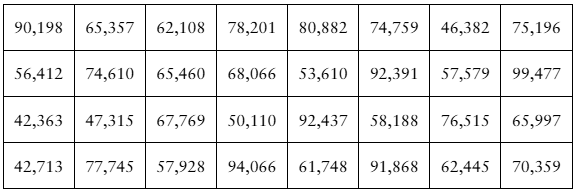
[APPLET] Earnings The annual earnings (in dollars) of 32 randomly selected intermediate level life insurance underwriters (Adapted from Salary.com)
Table displaying annual earnings in dollars of 32 life insurance underwriters, with values organized in rows and columns.

Verified step by step guidance
1
Step 1: Organize the data set provided into a list of values. These represent the annual earnings of 32 intermediate-level life insurance underwriters.
Step 2: Calculate the mean (average) of the data set. The formula for the mean is \( \text{Mean} = \frac{\sum x_i}{n} \), where \( x_i \) are the individual data points and \( n \) is the total number of data points.
Step 3: Compute the deviations of each data point from the mean. For each data point \( x_i \), calculate \( x_i - \text{Mean} \).
Step 4: Square each deviation to eliminate negative values and sum all the squared deviations. This gives \( \sum (x_i - \text{Mean})^2 \).
Step 5: Divide the sum of squared deviations by \( n-1 \) (since this is a sample standard deviation) and take the square root of the result. The formula for the sample standard deviation is \( s = \sqrt{\frac{\sum (x_i - \text{Mean})^2}{n-1}} \).

Verified video answer for a similar problem:

This video solution was recommended by our tutors as helpful for the problem above.
Video duration:
5m
Was this helpful?

Key Concepts

Here are the essential concepts you must grasp in order to answer the question correctly.

Sample Standard Deviation

The sample standard deviation is a measure of the amount of variation or dispersion in a set of sample data points. It quantifies how much the individual data points deviate from the sample mean. A higher standard deviation indicates greater variability among the data points, while a lower standard deviation suggests that the data points are closer to the mean.
Recommended video:
Guided course
08:45
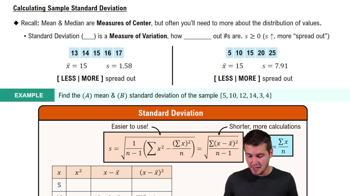
Calculating Standard Deviation

Confidence Interval

A confidence interval is a range of values, derived from a data set, that is likely to contain the true population parameter with a specified level of confidence, typically 95% or 99%. It provides an estimate of uncertainty around a sample statistic, allowing researchers to make inferences about the population from which the sample was drawn.
Recommended video:
06:33
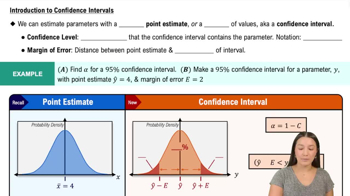
Introduction to Confidence Intervals

Random Sampling

Random sampling is a technique used to select a subset of individuals from a larger population, where each individual has an equal chance of being chosen. This method helps to ensure that the sample is representative of the population, reducing bias and allowing for more accurate statistical inferences about the population based on the sample data.
Recommended video:
05:11
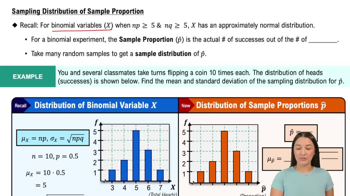
Sampling Distribution of Sample Proportion
Related Practice
Textbook Question

Constructing Confidence Intervals In Exercises 13–24, assume the sample is from a normally distributed population and construct the indicated confidence intervals for (b) the population standard deviation σ. Interpret the results.

Drug Concentration The times (in minutes) for the drug concentration to peak when the drug epinephrine is injected into 15 randomly selected patients are listed. Use a 90% level of confidence.

Textbook Question

Constructing Confidence Intervals In Exercises 13–24, assume the sample is from a normally distributed population and construct the indicated confidence intervals for (b) the population standard deviation σ. Interpret the results.

Car Batteries The reserve capacities (in hours) of 18 randomly selected automotive batteries have a sample standard deviation of 0.25 hour. Use an 80% level of confidence.

Textbook Question

Congress You wish to estimate, with 95% confidence, the population proportion of likely U.S. voters who think Congress is doing a good or excellent job. Your estimate must be accurate within 4% of the population proportion.

b. Find the minimum sample size needed, using a prior survey that found that 21% of likely U.S. voters think Congress is doing a good or excellent job. (Source: Rasmussen Reports)

Textbook Question

When all other quantities remain the same, how does the indicated change affect the width of a confidence interval? Explain.

b. Increase in the sample size

Textbook Question

Constructing Confidence Intervals In Exercises 13–24, assume the sample is from a normally distributed population and construct the indicated confidence intervals for (b) the population standard deviation σ. Interpret the results.

Annual Precipitation The annual precipitation amounts (in inches) of a random sample of 61 years for Chicago, Illinois, have a sample standard deviation of 6.46. Use a 98% level of confidence. (Source: National Oceanic and Atmospheric Administration)

Textbook Question

Constructing Confidence Intervals In Exercises 13–24, assume the sample is from a normally distributed population and construct the indicated confidence intervals for (a) the population variance σ^2. Interpret the results.

Volleyball The numbers of service aces scored by 15 teams randomly selected from the top 50 NCAA Division I Women’s Volleyball teams for the 2021 season have a sample standard deviation of 26.1. Use an 80% level of confidence. (Source: National Collegiate Athletic Association)