Ch. 5 - Normal Probability Distributions
Larson - Elementary Statistics: Picturing the World 8th Edition
Larson8th EditionElementary Statistics: Picturing the WorldISBN: 9780137493470Not the one you use?Change textbook
Chapter 5, Problem 5.Q.4d

The random variable x is normally distributed with the given parameters. Find each probability.


d. μ = 18.5, σ ≈ 4.25, P(19.6 < x < 26.1)

Verified step by step guidance
1
Step 1: Understand the problem. The random variable x is normally distributed with a mean (μ) of 18.5 and a standard deviation (σ) of approximately 4.25. We are tasked with finding the probability that x lies between 19.6 and 26.1, i.e., P(19.6 < x < 26.1).
Step 2: Standardize the values of x to convert them into z-scores using the formula: z = (x - μ) / σ. For the lower bound (x = 19.6), calculate z₁ = (19.6 - 18.5) / 4.25. For the upper bound (x = 26.1), calculate z₂ = (26.1 - 18.5) / 4.25.
Step 3: Use the standard normal distribution table (or a calculator) to find the cumulative probabilities corresponding to z₁ and z₂. Let Φ(z₁) represent the cumulative probability for z₁ and Φ(z₂) represent the cumulative probability for z₂.
Step 4: To find the probability that x lies between 19.6 and 26.1, subtract the cumulative probability for z₁ from the cumulative probability for z₂. This can be expressed as P(19.6 < x < 26.1) = Φ(z₂) - Φ(z₁).
Step 5: Interpret the result. The value obtained represents the probability that the random variable x falls within the specified range under the given normal distribution.

Verified video answer for a similar problem:

This video solution was recommended by our tutors as helpful for the problem above.
Video duration:
3m
Was this helpful?

Key Concepts

Here are the essential concepts you must grasp in order to answer the question correctly.

Normal Distribution

The normal distribution is a continuous probability distribution characterized by its bell-shaped curve, defined by its mean (μ) and standard deviation (σ). It is symmetric around the mean, meaning that approximately 68% of the data falls within one standard deviation from the mean, and about 95% falls within two standard deviations. This distribution is fundamental in statistics as many real-world phenomena tend to follow this pattern.
Recommended video:
06:23
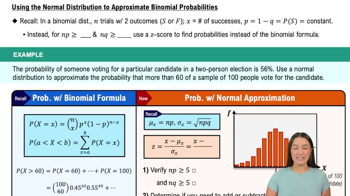
Using the Normal Distribution to Approximate Binomial Probabilities

Z-scores

A Z-score represents the number of standard deviations a data point is from the mean of a distribution. It is calculated using the formula Z = (X - μ) / σ, where X is the value of interest, μ is the mean, and σ is the standard deviation. Z-scores are essential for standardizing different normal distributions, allowing for the comparison of probabilities across different datasets.
Recommended video:
Guided course
06:31
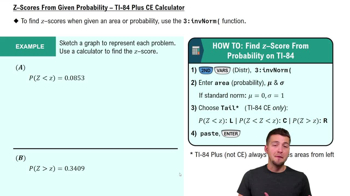
Z-Scores From Given Probability - TI-84 (CE) Calculator

Probability Calculation

Calculating probabilities for a normal distribution involves finding the area under the curve between two points, which can be done using Z-scores and standard normal distribution tables or software. For the given range P(19.6 < x < 26.1), one would first convert the values to Z-scores, then use the cumulative distribution function (CDF) to find the probabilities associated with these Z-scores and subtract them to find the desired probability.
Recommended video:
Guided course
07:09
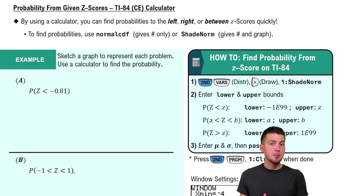
Probability From Given Z-Scores - TI-84 (CE) Calculator
Related Practice