Ch. 5 - Normal Probability Distributions
Larson - Elementary Statistics: Picturing the World 8th Edition
Larson8th EditionElementary Statistics: Picturing the WorldISBN: 9780137493470Not the one you use?Change textbook
Chapter 5, Problem 5.Q.11

In a survey of U.S. adults, 81% feel they have little or no control over data collected about them by companies. You randomly select 250 U.S. adults and ask them whether they feel they have control over data collected about them by companies. Use this information in Exercises 11 and 12. (Source: Pew Research Center)


Determine whether you can use a normal distribution to approximate the binomial distribution. If you can, find the mean and standard deviation. If you cannot, explain why.

Verified step by step guidance
1
Step 1: Identify the problem type. This is a binomial distribution problem because there are two possible outcomes: either a person feels they have little or no control over their data, or they do not.
Step 2: Check the conditions for approximating a binomial distribution with a normal distribution. The conditions are: (1) The sample size (n) must be large enough, and (2) both np and n(1-p) must be greater than or equal to 5. Here, n = 250 and p = 0.81.
Step 3: Calculate np and n(1-p). Use the formulas: np = n × p and n(1-p) = n × (1-p). Substitute the values of n and p into these formulas.
Step 4: If both np and n(1-p) are greater than or equal to 5, then the normal approximation can be used. If not, explain why the approximation is not valid.
Step 5: If the normal approximation is valid, calculate the mean (μ) and standard deviation (σ) of the binomial distribution. Use the formulas: μ = n × p and σ = √(n × p × (1-p)). Substitute the values of n and p into these formulas to find the mean and standard deviation.

Verified video answer for a similar problem:

This video solution was recommended by our tutors as helpful for the problem above.
Video duration:
6m
Was this helpful?

Key Concepts

Here are the essential concepts you must grasp in order to answer the question correctly.

Binomial Distribution

A binomial distribution models the number of successes in a fixed number of independent Bernoulli trials, each with the same probability of success. In this context, the success could be defined as an adult feeling they have control over their data. The distribution is characterized by two parameters: the number of trials (n) and the probability of success (p).
Recommended video:
Guided course
03:28
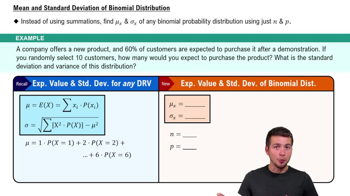
Mean & Standard Deviation of Binomial Distribution

Normal Approximation

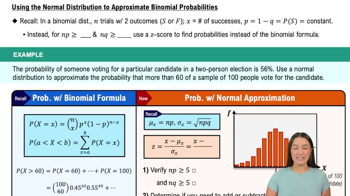
The normal approximation to the binomial distribution is applicable when certain conditions are met, specifically when both np and n(1-p) are greater than or equal to 5. This allows the binomial distribution to be approximated by a normal distribution, making calculations easier, especially for larger sample sizes. In this case, you would check if these conditions hold for the given sample size and probability.
Recommended video:
06:23
Using the Normal Distribution to Approximate Binomial Probabilities

Mean and Standard Deviation of a Binomial Distribution

The mean (μ) of a binomial distribution is calculated as μ = np, where n is the number of trials and p is the probability of success. The standard deviation (σ) is given by σ = √(np(1-p)). These measures provide insights into the expected number of successes and the variability around that expectation, which are essential for understanding the distribution's behavior.
Recommended video:
Guided course
03:28
Mean & Standard Deviation of Binomial Distribution