Ch. 5 - Normal Probability Distributions
Larson - Elementary Statistics: Picturing the World 8th Edition
Larson8th EditionElementary Statistics: Picturing the WorldISBN: 9780137493470Not the one you use?Change textbook
Chapter 5, Problem 5.R.60a

In Exercises 55–60, find the indicated probabilities and interpret the results.


The mean annual salary for physical therapists in the United States is about \$87,000. A random sample of 50 physical therapists is selected. What is the probability that the mean annual salary of the sample is (a) less than \(84,000? Assume sigma = \)10,500.

Verified step by step guidance
1
Step 1: Identify the key parameters of the problem. The population mean (μ) is \$87,000, the population standard deviation (σ) is \$10,500, the sample size (n) is 50, and we are tasked with finding the probability that the sample mean is less than \$84,000.
Step 2: Recall the formula for the standard error of the mean (SEM), which is used to measure the variability of the sample mean. The formula is: SEM = σn. Substitute σ = 10,500 and n = 50 into the formula to calculate the SEM.
Step 3: Standardize the sample mean using the z-score formula for a sampling distribution: z = - μSEM. Here, X̄ = \(84,000, μ = \)87,000, and SEM is the value calculated in Step 2. Substitute these values into the formula to compute the z-score.
Step 4: Use the z-score obtained in Step 3 to find the corresponding probability. Refer to the standard normal distribution table (z-table) or use statistical software to determine the cumulative probability associated with the z-score.
Step 5: Interpret the result. The cumulative probability represents the likelihood that the sample mean annual salary of 50 physical therapists is less than \$84,000. Express this probability as a percentage and provide context for the result.

Verified video answer for a similar problem:

This video solution was recommended by our tutors as helpful for the problem above.
Video duration:
5m
Was this helpful?

Key Concepts

Here are the essential concepts you must grasp in order to answer the question correctly.

Central Limit Theorem

The Central Limit Theorem states that the distribution of the sample mean will approach a normal distribution as the sample size increases, regardless of the shape of the population distribution. This theorem is crucial for calculating probabilities related to sample means, especially when the sample size is sufficiently large, such as the sample of 50 physical therapists in this question.
Recommended video:
Guided course
04:52
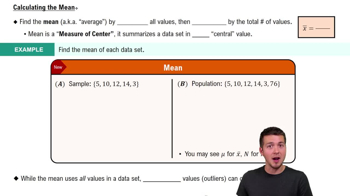
Calculating the Mean

Standard Error

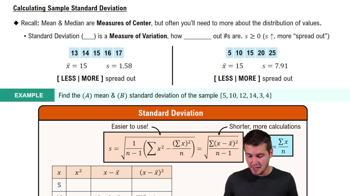
Standard Error (SE) measures the dispersion of sample means around the population mean. It is calculated by dividing the population standard deviation (sigma) by the square root of the sample size. In this case, with a sigma of $10,500 and a sample size of 50, the SE will help determine how much variability we can expect in the sample mean compared to the population mean.
Recommended video:
Guided course
08:45
Calculating Standard Deviation

Z-Score

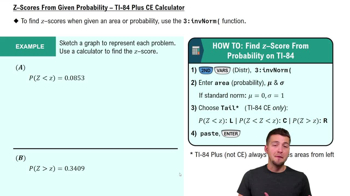
A Z-score indicates how many standard deviations an element is from the mean. It is calculated by subtracting the population mean from the sample mean and then dividing by the standard error. In this scenario, calculating the Z-score for a sample mean of $84,000 will allow us to find the corresponding probability using the standard normal distribution.
Recommended video:
Guided course
06:31
Z-Scores From Given Probability - TI-84 (CE) Calculator