Ch. 5 - Normal Probability Distributions
Larson - Elementary Statistics: Picturing the World 8th Edition
Larson8th EditionElementary Statistics: Picturing the WorldISBN: 9780137493470Not the one you use?Change textbook
Chapter 5, Problem 5.R.13c

An auto parts seller finds that 1 in every 200 parts sold is defective. Use the geometric distribution to find the probability that (c) none of the first 20 parts sold are defective.

Verified step by step guidance
1
Step 1: Recognize that the problem involves a geometric distribution, which models the number of trials until the first success (or failure, depending on the context). Here, the 'success' is finding a defective part, and the probability of success (p) is given as 1/200 = 0.005.
Step 2: Recall the formula for the probability of no successes (defective parts) in the first n trials in a geometric distribution: \( P(X > n) = (1 - p)^n \), where \( p \) is the probability of success and \( n \) is the number of trials.
Step 3: Substitute the given values into the formula. Here, \( p = 0.005 \) and \( n = 20 \). The formula becomes \( P(X > 20) = (1 - 0.005)^{20} \).
Step 4: Simplify the expression \( 1 - 0.005 \) to get \( 0.995 \), and then raise it to the power of 20. This represents the probability that none of the first 20 parts sold are defective.
Step 5: Interpret the result. The calculated probability represents the likelihood that all 20 parts sold are non-defective, based on the given defect rate of 1 in 200 parts.

Verified video answer for a similar problem:

This video solution was recommended by our tutors as helpful for the problem above.
Video duration:
2m
Was this helpful?

Key Concepts

Here are the essential concepts you must grasp in order to answer the question correctly.

Geometric Distribution

The geometric distribution models the number of trials needed to achieve the first success in a series of independent Bernoulli trials. In this context, a 'success' refers to selling a defective part. The probability of success is constant, and the distribution is defined by the probability of failure, which allows us to calculate the likelihood of observing a certain number of failures before the first success.
Recommended video:
Guided course
06:38
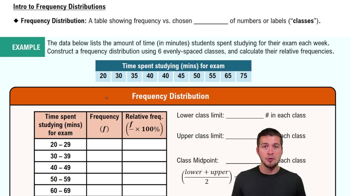
Intro to Frequency Distributions

Probability of Success and Failure

In probability theory, the probability of success is the likelihood of an event occurring, while the probability of failure is the likelihood of it not occurring. For the auto parts seller, the probability of selling a defective part (success) is 1/200, and the probability of selling a non-defective part (failure) is 199/200. Understanding these probabilities is crucial for calculating outcomes using the geometric distribution.
Recommended video:
5:37
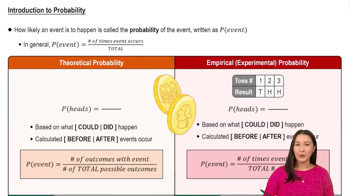
Introduction to Probability

Cumulative Probability

Cumulative probability refers to the probability that a random variable takes on a value less than or equal to a certain threshold. In this case, we are interested in the probability that none of the first 20 parts sold are defective, which involves calculating the cumulative probability of 20 consecutive failures. This is done by raising the probability of failure to the power of the number of trials, reflecting the independent nature of each sale.
Recommended video:
5:37
Introduction to Probability