Ch. 5 - Normal Probability Distributions
Larson - Elementary Statistics: Picturing the World 8th Edition
Larson8th EditionElementary Statistics: Picturing the WorldISBN: 9780137493470Not the one you use?Change textbook
Chapter 5, Problem 5.RE.5

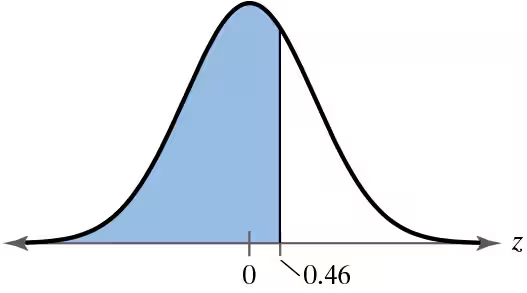
In Exercises 5 and 6, find the area of the indicated region under the standard normal curve. If convenient, use technology to find the area.


<IMAGE>

Verified step by step guidance
1
Step 1: Understand the problem. The goal is to find the area under the standard normal curve to the left of z = 0.46. This represents the cumulative probability for z-values less than or equal to 0.46.
Step 2: Recall that the standard normal curve is symmetric about z = 0, with a mean of 0 and a standard deviation of 1. The area under the curve represents probabilities.
Step 3: Use the standard normal table (z-table) or technology (such as a graphing calculator or statistical software) to find the cumulative probability corresponding to z = 0.46. The z-table provides the area to the left of a given z-value.
Step 4: If using technology, input the z-value (0.46) into the software or calculator to compute the cumulative probability. Ensure the tool is set to standard normal distribution.
Step 5: Interpret the result. The area under the curve to the left of z = 0.46 represents the probability of a random variable from a standard normal distribution being less than or equal to 0.46.

Verified video answer for a similar problem:

This video solution was recommended by our tutors as helpful for the problem above.
Video duration:
1m
Was this helpful?

Key Concepts

Here are the essential concepts you must grasp in order to answer the question correctly.

Standard Normal Distribution

The standard normal distribution is a special case of the normal distribution where the mean is 0 and the standard deviation is 1. It is represented by the bell-shaped curve, and all values are expressed in terms of z-scores, which indicate how many standard deviations an element is from the mean. This distribution is crucial for calculating probabilities and areas under the curve.
Recommended video:
Guided course
09:47
Finding Standard Normal Probabilities using z-Table

Z-Score

A z-score is a statistical measurement that describes a value's relationship to the mean of a group of values. It is calculated by subtracting the mean from the value and then dividing by the standard deviation. Z-scores allow for the comparison of scores from different distributions and are essential for finding areas under the standard normal curve.
Recommended video:
Guided course
06:31
Z-Scores From Given Probability - TI-84 (CE) Calculator

Area Under the Curve

The area under the curve (AUC) in a probability distribution represents the likelihood of a random variable falling within a particular range. For the standard normal distribution, this area can be calculated using z-scores and is often found using statistical tables or technology. The AUC is fundamental in hypothesis testing and confidence interval estimation.
Recommended video:
Guided course
08:50
Z-Scores from Probabilities