Ch. 4 - Discrete Probability Distributions
Larson - Elementary Statistics: Picturing the World 8th Edition
Larson8th EditionElementary Statistics: Picturing the WorldISBN: 9780137493470Not the one you use?Change textbook
Chapter 4, Problem 4.RS.1a

The Centers for Disease Control and Prevention (CDC) is required by law to publish a report on assisted reproductive technology (ART). ART includes all fertility treatments in which both the egg and the sperm are used. These procedures generally involve removing eggs from a patient’s ovaries, combining them with sperm in the laboratory, and returning them to the patient’s body or giving them to another patient.

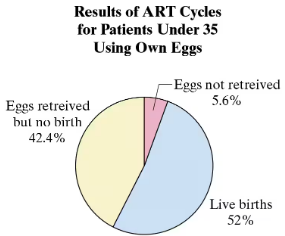
You are helping to prepare a CDC report on young ART patients and select at random 6 ART cycles of patients under 35 years of age for a special review. None of the cycles resulted in a live birth. Your manager feels it is impossible to select at random 10 ART cycles that do not result in a live birth. Use the pie chart at the right and your knowledge of statistics to determine whether your manager is correct.
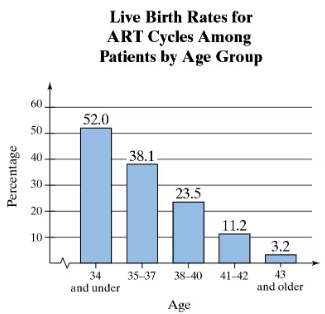
Bar graph showing live birth rates for ART cycles by age group, with percentages decreasing from 52% for 34 and under to 3.2% for 43 and older.
a. How would you determine whether your manager is correct, that it is impossible to select at random six ART cycles that do not result in a live birth?

Verified step by step guidance
1
Step 1: Analyze the pie chart provided. The pie chart shows the distribution of ART cycle outcomes for patients under 35 using their own eggs. Specifically, 52% of cycles result in live births, 42.4% result in eggs retrieved but no birth, and 5.6% result in eggs not retrieved.
Step 2: Understand the manager's claim. The manager believes it is impossible to randomly select 10 ART cycles that do not result in a live birth. To evaluate this claim, we need to calculate the probability of selecting cycles that do not result in live births.
Step 3: Use the probability of 'no live birth' from the pie chart. The probability of selecting a cycle that does not result in a live birth is the sum of the probabilities of 'eggs retrieved but no birth' (42.4%) and 'eggs not retrieved' (5.6%), which equals 48%.
Step 4: Apply the binomial probability formula. To determine the likelihood of selecting 10 cycles that do not result in a live birth, use the binomial probability formula: \( P(X = k) = \binom{n}{k} p^k (1-p)^{n-k} \), where \( n \) is the number of trials (10 cycles), \( k \) is the number of successes (cycles without live births), and \( p \) is the probability of success (0.48).
Step 5: Interpret the results. Calculate the probability for \( k = 10 \) (all 10 cycles resulting in no live birth). If the probability is non-zero, it is possible to select 10 cycles without live births, even if the probability is very small. This would refute the manager's claim.

Verified video answer for a similar problem:

This video solution was recommended by our tutors as helpful for the problem above.
Video duration:
3m
Was this helpful?

Key Concepts

Here are the essential concepts you must grasp in order to answer the question correctly.

Random Sampling

Random sampling is a statistical technique where each member of a population has an equal chance of being selected. This method helps ensure that the sample is representative of the population, reducing bias. In the context of the ART cycles, random sampling would involve selecting cycles without any predetermined criteria, allowing for a fair assessment of outcomes.
Recommended video:
05:11
Sampling Distribution of Sample Proportion

Probability

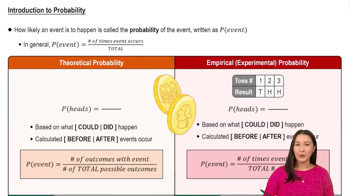
Probability is a measure of the likelihood that a particular event will occur, expressed as a number between 0 and 1. In this scenario, understanding the probability of selecting ART cycles that do not result in a live birth is crucial. Given the pie chart data, one can calculate the probability of selecting cycles with no live births to determine if it is feasible to randomly select six such cycles.
Recommended video:
5:37
Introduction to Probability

Statistical Inference

Statistical inference involves drawing conclusions about a population based on sample data. In this case, the manager's assertion can be evaluated by analyzing the sample of ART cycles and the associated probabilities. By applying statistical inference, one can assess whether the observed outcomes align with the expected probabilities, thus determining the validity of the manager's claim.
Recommended video:
Guided course
05:53
Parameters vs. Statistics
Related Practice
Textbook Question

In Exercises 1–3, find the indicated probabilities using the geometric distribution, the Poisson distribution, or the binomial distribution. Then determine whether the events are unusual. If convenient, use a table or technology to find the probabilities.

One out of every 42 tax returns for incomes over \$1 million requires an audit. An auditor is examining tax returns for over \$1 million. Find the probability that (b) the first return requiring an audit is the first or second return the tax auditor examines, 

1
views
Textbook Question

In Exercises 13–16, find the indicated binomial probabilities. If convenient, use technology or Table 2 in Appendix B.

Fifty-three percent of U.S. adults support attempting to land an astronaut on Mars. You randomly select eight U.S. adults. Find the probability that the number who support attempting to land an astronaut on Mars is (a) exactly three

1
views
Textbook Question

In Exercises 1–7, consider a grocery store that can process a total of four customers at its checkout counters each minute.

Minitab was used to generate 20 random numbers with a Poisson distribution for . Let the random number represent the number of arrivals at the checkout counter each minute for 20 minutes. 3 3 3 3 5 5 6 7 3 6 3 5 6 3 4 6 2 2 4 1During each of the first four minutes, only three customers arrived. These customers could all be processed, so there were no customers waiting after four minutes.

b. Create a table that shows the number of customers waiting at the end of 1 through 20 minutes.

Textbook Question

In Exercises 13–16, find the indicated binomial probabilities. If convenient, use technology or Table 2 in Appendix B.

Seventy-two percent of U.S. civilian employees have access to medical care benefits. You randomly select nine civilian employees. Find the probability that the number who have access to medical care benefits is (a) exactly six

1
views
Textbook Question

In Exercises 13–16, find the indicated binomial probabilities. If convenient, use technology or Table 2 in Appendix B.

Fifty-three percent of U.S. adults support attempting to land an astronaut on Mars. You randomly select eight U.S. adults. Find the probability that the number who support attempting to land an astronaut on Mars is (c) more than three.

1
views
Textbook Question

The Centers for Disease Control and Prevention (CDC) is required by law to publish a report on assisted reproductive technology (ART). ART includes all fertility treatments in which both the egg and the sperm are used. These procedures generally involve removing eggs from a patient’s ovaries, combining them with sperm in the laboratory, and returning them to the patient’s body or giving them to another patient.

You are helping to prepare a CDC report on young ART patients and select at random 6 ART cycles of patients under 35 years of age for a special review. None of the cycles resulted in a live birth. Your manager feels it is impossible to select at random 10 ART cycles that do not result in a live birth. Use the pie chart at the right and your knowledge of statistics to determine whether your manager is correct.

b. What probability distribution do you think best describes the situation? Do you think the distribution of the number of live births is discrete or continuous? Explain your reasoning.