
Textbook Question
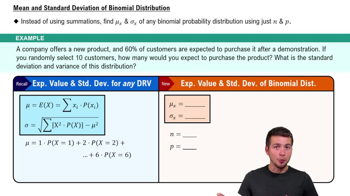
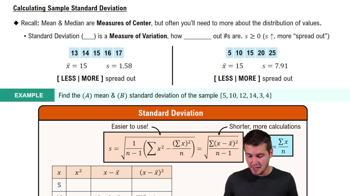
In Exercises 7 and 8, (a) find the mean, variance, and standard deviation of the probability distribution, and (b) interpret the results.
The number of cell phones per household in a small town

 Verified step by step guidance
 03:28
03:28
 08:45
08:45 06:50
06:50In Exercises 7 and 8, (a) find the mean, variance, and standard deviation of the probability distribution, and (b) interpret the results.
The number of cell phones per household in a small town
In Exercises 17 and 18, (a) construct a binomial distribution, (b) graph the binomial distribution using a histogram and describe its shape, and (c) identify any values of the random variable x that you would consider unusual. Explain your reasoning.
Seventy-two percent of U.S adults have read a book in any format in the past year. You randomly select five U.S adults and ask them whether they have read a book in any format in the past year. The random variable represents the number of adults who have read a book in any format in the past year. (Source: Pew Research)
In Exercises 9 and 10, find the expected net gain to the player for one play of the game.
It costs \(25 to bet on a horse race. The horse has a 1/8 chance of winning and a 1/4 chance of placing second or third. You win \)125 if the horse wins and receive your money back if the horse places second or third.
In Exercises 21–26, find the indicated probabilities using the geometric distribution, the Poisson distribution, or the binomial distribution. Then determine whether the events are unusual. If convenient, use a table or technology to find the probabilities.
Fourteen percent of noninstitutionalized U.S. adults smoke cigarettes. After randomly selecting ten noninstitutionalized U.S. adults, you ask them whether they smoke cigarettes. Find the probability that the first adult who smokes cigarettes is (a) the third person selected.
In Exercises 21–26, find the indicated probabilities using the geometric distribution, the Poisson distribution, or the binomial distribution. Then determine whether the events are unusual. If convenient, use a table or technology to find the probabilities
Thirty-six percent of Americans think there is still a need for the practice of changing their clocks for Daylight Savings Time. You randomly select seven Americans. Find the probability that the number who say there is still a need for changing their clocks for Daylight Savings Time is (a) exactly four
In Exercises 3 and 4, (a) construct a probability distribution, and (b) graph the probability distribution using a histogram and describe its shape.
The number of hours students in a college class slept the previous night