Ch. 3 - Probability
Larson - Elementary Statistics: Picturing the World 8th Edition
Larson8th EditionElementary Statistics: Picturing the WorldISBN: 9780137493470Not the one you use?Change textbook
Chapter 3, Problem 3.2.25d

Using the Multiplication Rule In Exercises 19-32, use the Multiplication Rule.
25. Best President In a sample of 1500 adult U.S. citizens, 270 said that Barack Obama was the best president in U.S. history. Two adult U.S. citizens are selected at random.
(Adapted from YouGov)
d. Which of the events can be considered unusual? Explain.

Verified step by step guidance
1
Step 1: Understand the problem. We are tasked with determining which events can be considered unusual when two adult U.S. citizens are selected at random. To do this, we will use the Multiplication Rule and the concept of unusual events, which are typically defined as events with a probability less than 0.05.
Step 2: Calculate the probability of selecting one adult who believes Barack Obama was the best president. This is done by dividing the number of adults who believe this (270) by the total sample size (1500). The probability is given by: 2701500.
Step 3: Use the Multiplication Rule to calculate the probability of selecting two such adults in a row. The Multiplication Rule states that the probability of two independent events A and B occurring is the product of their individual probabilities: PAB = PAPB. Adjust for the fact that the second selection is without replacement, so the probability for the second selection is slightly different.
Step 4: Determine the adjusted probability for the second selection. After one adult is selected, there are 1499 adults remaining, and 269 of them believe Barack Obama was the best president. The probability for the second selection is: 2691499.
Step 5: Multiply the probabilities from Step 2 and Step 4 to find the overall probability of selecting two such adults in a row. Compare this probability to the threshold for unusual events (0.05). If the probability is less than 0.05, the event is considered unusual. Interpret the result and explain whether the event is unusual or not.

Verified video answer for a similar problem:

This video solution was recommended by our tutors as helpful for the problem above.
Video duration:
3m
Was this helpful?

Key Concepts

Here are the essential concepts you must grasp in order to answer the question correctly.

Multiplication Rule

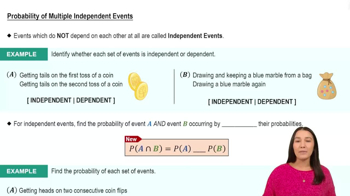
The Multiplication Rule in probability states that the probability of two independent events occurring together is the product of their individual probabilities. This rule is essential for calculating the likelihood of multiple outcomes happening simultaneously, especially when events do not influence each other.
Recommended video:
05:54
Probability of Multiple Independent Events

Probability of an Event

Probability quantifies the likelihood of an event occurring, expressed as a number between 0 and 1. In this context, it helps determine how likely it is for randomly selected individuals to share a specific opinion, such as believing Barack Obama was the best president.
Recommended video:
05:54
Probability of Multiple Independent Events

Unusual Events

An event is considered unusual if its probability is significantly low, often defined as less than 5%. Identifying unusual events helps in understanding outcomes that deviate from what is expected, which is crucial for interpreting the results of the survey in the context of public opinion.
Recommended video:
05:54
Probability of Multiple Independent Events
Related Practice
Textbook Question

50. Investment Committee A company has 200 employees, consisting of 144 women and 56 men. The company wants to select five employees to serve as an investment committee.

d. Explain how the company can select a representative sample of the male and female population of employees.

Textbook Question

26. Eye Survey The table shows the results of a survey that asked 3203 people whether they wore contacts or glasses. A person is selected at random from the sample. Find the probability of each event.

d. The person is male or does not wear glasses.

" style="max-width: 100%; white-space-collapse: preserve;" width="480">

Textbook Question

22. Brexit A survey asked 1115 British adults how Britain's decision to leave the European Union has impacted the country. The results are shown in the Pareto chart. Find the

probability of each event. (Adapted from Ipsos)

d. Randomly selecting a British adult who feels that the move has had a fairly positive or very positive impact on Great Britain

Textbook Question

Politics The responses of 1500 U.S. adults to a survey that asked them to state their own political viewpoints are shown in the Pareto chart. Find the probability of each event.(Adapted from YouGov)

d. Randomly selecting a person from the sample who is either unsure or moderate


Textbook Question

2. Determine whether each number could represent the probability of an event. Explain your reasoning. d. -0.0004

Textbook Question

Marijuana Use The percent distribution of the last marijuana use (either medical or nonmedical) for a sample of 13,373 college students is shown in the pie chart. Find the

probability of each event. (Source: American College Health Association)

d. Randomly selecting a student who has not used marijuana within the last 12 months