
Ch. 3 - Probability
Larson - Elementary Statistics: Picturing the World 8th Edition
Larson8th EditionElementary Statistics: Picturing the WorldISBN: 9780137493470Not the one you use?Change textbook
Chapter 3, Problem 3.1.2d

2. Determine whether each number could represent the probability of an event. Explain your reasoning. d. -0.0004

Verified step by step guidance
1
Understand the definition of probability: Probability is a measure of the likelihood of an event occurring, and it is always a value between 0 and 1, inclusive. This means that probabilities cannot be negative or exceed 1.
Examine the given number: The problem provides the value -0.0004, which is a negative number.
Compare the given number to the valid range for probabilities: Since probabilities must be between 0 and 1, inclusive, any negative number is not a valid probability.
Explain the reasoning: The value -0.0004 cannot represent the probability of an event because it falls outside the valid range for probabilities (0 ≤ P ≤ 1).
Conclude: Based on the definition of probability and the given value, -0.0004 is not a valid probability.

Verified video answer for a similar problem:

This video solution was recommended by our tutors as helpful for the problem above.
Video duration:
1m
Was this helpful?

Key Concepts

Here are the essential concepts you must grasp in order to answer the question correctly.

Probability Range

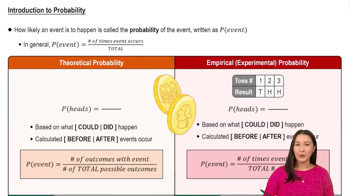
Probability is a measure of the likelihood of an event occurring, and it is always expressed as a number between 0 and 1. A probability of 0 indicates that an event will not occur, while a probability of 1 indicates certainty that the event will occur. Any number outside this range, such as negative values or values greater than 1, cannot represent a valid probability.
Recommended video:
5:37
Introduction to Probability

Negative Numbers in Probability

Negative numbers are not valid in the context of probability because they do not have a meaningful interpretation in this framework. Probabilities must reflect a non-negative measure of likelihood, and a negative value, like -0.0004, suggests an impossibility or an error in calculation, making it unsuitable for representing the chance of any event.
Recommended video:
5:37
Introduction to Probability

Interpretation of Probabilities

Understanding how to interpret probabilities is crucial for analyzing events. Probabilities provide a quantitative way to express uncertainty and are used in various fields, including statistics and risk assessment. Recognizing that probabilities must be non-negative helps in evaluating whether a given number can logically represent the likelihood of an event.
Recommended video:
5:37
Introduction to Probability